Rooms
Noren: The Half-Curtain Japanese Homes Hang Instead of a Real Door
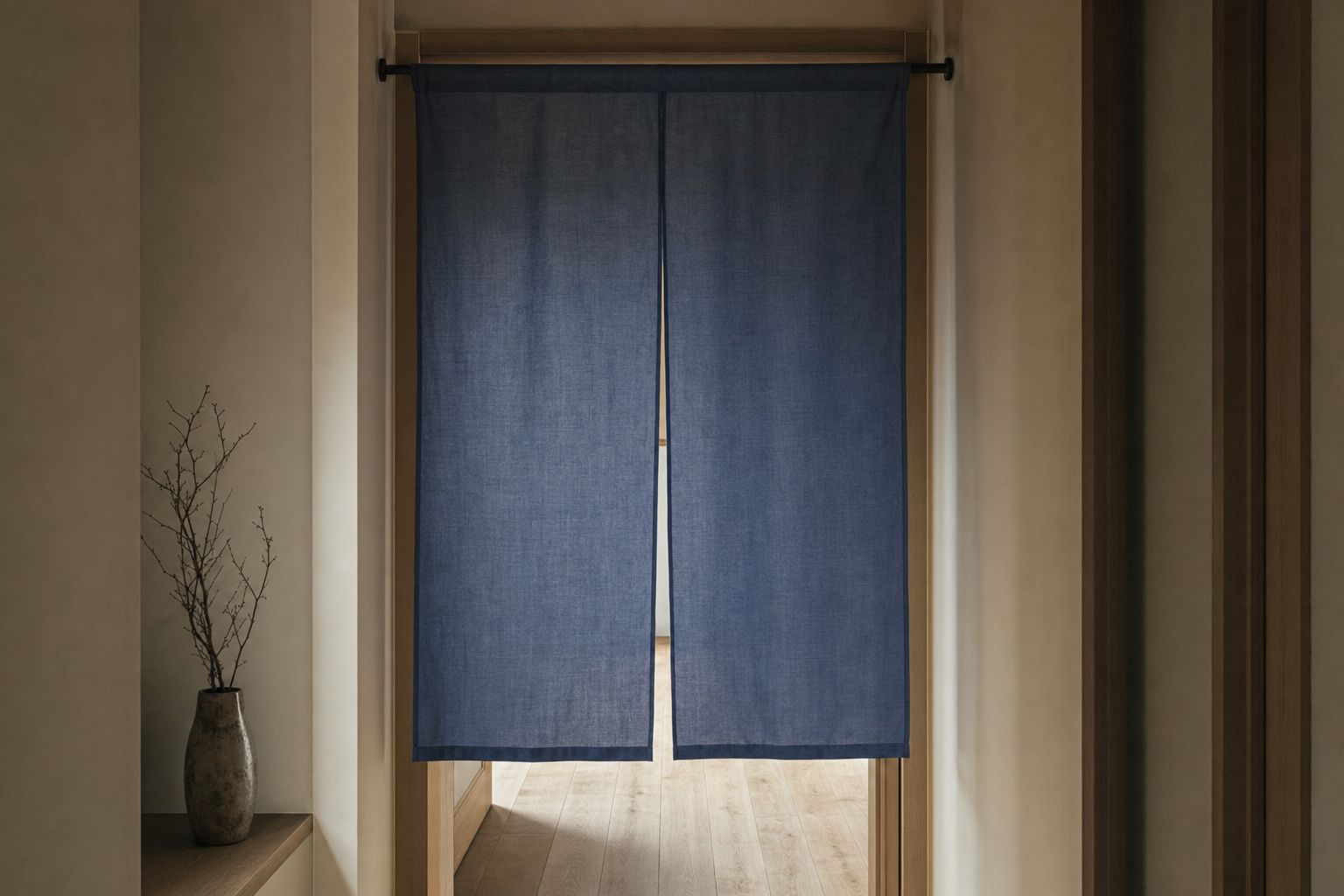
A lot of Japandi boards treat the noren as wall art — a nice stripe of indigo fabric to hang somewhere for texture. It’s not decoration first. A noren is a curtain with a slit cut up the middle so you can walk through it without opening anything, and Japanese shops still use it the way they always have: hang it out front and you’re open, take it down and you’re closed. The short version: it’s cheap to start (a basic one runs about ¥110 at Daiso), it goes up on a tension rod with no drilling, and the main thing worth knowing before you buy one is which length actually works for your doorway, because the naming on that is more inconsistent than it should be.
It’s a sign before it’s a curtain
Walk down a shopping street in Japan and the noren hanging outside a shop is doing a job a sign usually does elsewhere: it’s telling you the shop is open, and it’s telling you roughly what kind of shop it is. A public bathhouse, a sento, is identifiable by its noren alone — marked with the hiragana character for hot water, ゆ. Historically the colors carried meaning too: red signaled the old pleasure quarters, white was for groceries, pharmacies, and candy shops. A restaurant’s noren usually carries its name dyed straight into the fabric, which is also why a shop takes its noren down at closing time rather than leaving it up. The curtain is the “open” sign.
That’s worth knowing before you hang one at home, because it reframes what you’re buying. You’re not buying a piece of fabric art. You’re buying the thing a shopkeeper takes down every night.
The slit is the whole point
Here’s the detail that gets lost when a noren shows up as a flat photo on a mood board: it’s split into panels — usually two, sometimes three or four — with a gap down the middle of each seam. That gap is the entire mechanical idea. A door blocks a doorway completely until someone opens it. A noren blocks most of a doorway, all the time, while letting a person walk straight through without using a hand. You duck your head slightly, the two halves part around you, and they fall back into place behind you.
That’s a genuinely useful compromise for a space that needs airflow and light but not a full view through — a kitchen entrance where steam needs somewhere to go, a hallway where you want to block a cold draft from one room without boxing the space in, a closet front you want to keep dust off without a swinging door eating floor space when it’s open.
Length matters more than the product photo suggests
Shop listings split noren into roughly two categories, but the exact cutoff isn’t standardized the way a size chart would be, so don’t trust the label alone.
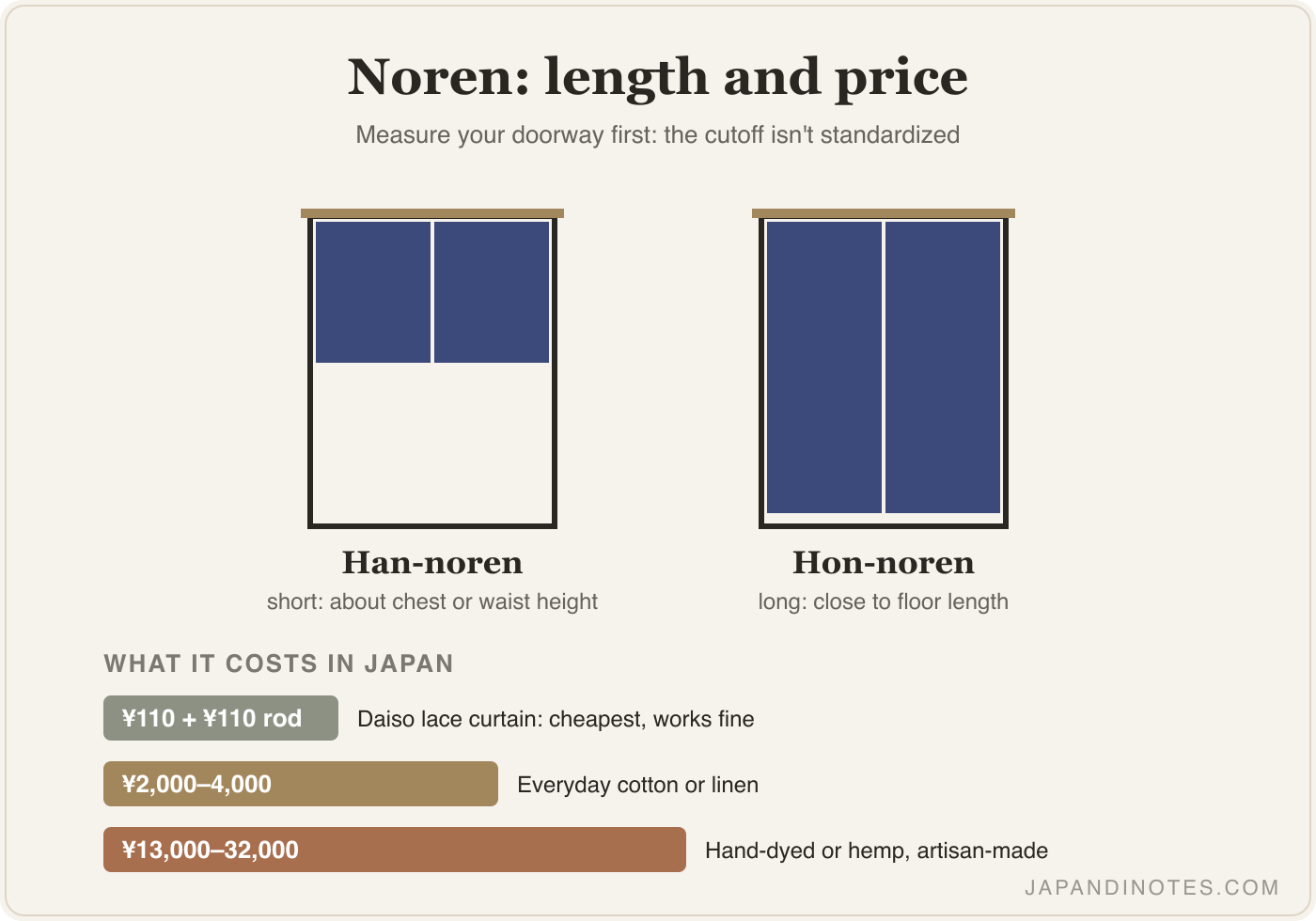
A han-noren (“half noren”) is the short style — it typically hangs from around eye level or the top of a doorway down to somewhere around chest or waist height, the kind you see at a ramen counter where the idea is to screen the entrance without blocking the view of who’s inside.
A hon-noren (“full noren” or just a longer drop) runs most of the way down the doorway, closer to floor length, which is what you want if the goal is actually blocking a draft or a sightline into a room, not just marking it.
Widths run anywhere from about 85cm up to 145cm or more depending on the maker, and heights for a standard doorway piece commonly range from roughly 50cm up to 170cm. None of that is universal. Measure your actual doorway — width and the height you want it to drop — before you order, because two listings both labeled “half noren” can be a genuinely different length.
What it actually costs in Japan
This is the part most English-language write-ups skip, and it matters because the price range is wider than you’d guess from Etsy or Amazon listings alone.
At the cheap end, Daiso sells a plain lace noren for ¥110 — about 85cm wide by 100cm tall, in white, beige, or a light color, with a couple of printed patterns available (a Nordic-leaf print and a square-dot print in the lineup I found). The curtain rod isn’t included; Daiso sells a separate telescoping rod, roughly 70–120cm, also for ¥110. So a complete, working setup from one store is under ¥300 before tax.
Mid-range interior shops and home centers carry printed cotton or linen noren, and the ones I could find priced landed mostly in the ¥2,000–4,000 range, with the number climbing from there depending on size and whether the pattern is printed or actually dyed. At the top end, a specialty craft retailer like the Kyoto Handicraft Center sells hand-dyed or natural-hemp pieces anywhere from around ¥13,000 up to ¥32,000 — the kind of noren a shop owner commissions with their own business name dyed into it.
The honest take: skip the premium end unless you specifically want a dyed, artisan piece as the object itself. A ¥110 Daiso curtain and a ¥110 rod do the actual job — partial privacy, a bit of texture — just as well as a ¥20,000 one does. The one real downside of the lace version specifically: it’s sheer, so it screens a sightline without blocking much light at all, which is the wrong pick if what you actually want is to darken a room or hide a messy closet behind it. What you’re paying extra for past a certain point is craft and provenance, not function.
Hanging one without touching the wall
The reason a noren works for renters is the same reason a shower curtain works for renters: it hangs from a horizontal pole that sits in tension between two surfaces, no screws required. A spring-tension curtain rod sized to your doorway width goes up in a couple of minutes, and most noren ship with fabric loops or a rod pocket sewn into the top edge specifically built for this. If your doorway is wider than the rod’s maximum reach, a cafe-curtain rod from any home-goods aisle will usually stretch further than the Daiso one does.
One thing worth doing before you buy: check whether the doorway has a trim ledge or molding you can rest the rod ends against, rather than relying purely on tension against drywall. Drywall alone, over time, dents.
What’s not worth buying
Skip the oversized printed polyester noren aimed at tourists — the kind with a cartoon koi or a giant “SUSHI” printed across it in a faux-brush font. They photograph fine from across a room and look thin and synthetic the moment you’re standing in the doorway with one, because the point of a real noren is partly the weight and drape of the fabric, and a lightweight printed polyester panel doesn’t drape — it just hangs flat and a little stiff. A plain cotton or linen one in a single color does more for an actual room than a loud printed one does, even at the same price.
Where I’m honestly guessing and where I’m not
I haven’t picked one out for our own place, so I can’t tell you which rod brand holds up best over time. What I can say honestly: my wife’s family is from Tango, up the coast from Kyoto, and that part of Kyoto Prefecture is actually known for its own textile tradition — tango chirimen, a crimped silk crepe that’s supplied a large share of Japan’s kimono fabric for generations. It’s a dyeing-and-weaving region more than a noren-specific one, and I genuinely don’t know whether her parents’ house has a noren hanging anywhere. I haven’t asked, so I’m not going to pretend I have.
Quick recap:
- A noren is a split curtain that shops hang when open and take down when closed — a working sign, not just a texture piece.
- Han-noren (short) and hon-noren (long) aren’t standardized lengths, so measure your doorway before ordering.
- A ¥110 Daiso curtain and ¥110 rod do the same practical job as a ¥20,000 artisan one; the gap in price is mostly craft and provenance.
Your next step, if you’ve got a doorway that’s always bugged you — too open, too drafty, too much of a sightline into a messy closet — is to measure it tonight before you forget, then decide whether you actually want chest-height or floor-length.
— Sen
The color logic behind why indigo is the one bright color that fits a Japandi room without fighting it is worked out in the Japandi color palette guide; the genkan, the other threshold every Japanese home treats as its own small ritual, gets the same close look in the entryway guide; a kitchen doorway is one of the more common places to actually use one, covered in the Japandi kitchen guide; and the closet-front version of this same curtain-instead-of-door idea shows up again in the closet storage piece.
Wabi-sabi: let it be imperfect.

From our print shop
Wall art, made with this palette
Two collections built on the exact five colors from this site — watercolor landscapes and sumi-e botanicals. Instant download, five print sizes per artwork.
See all the prints →The 5 Japandi Principles (Free Cheat Sheet)
The five ideas that actually transfer from real Japanese homes — printable, one page, free.
Get the cheat sheet →