Rooms
The Japandi Closet: What Oshiire Storage Actually Solves (Most Fixes Under $40)
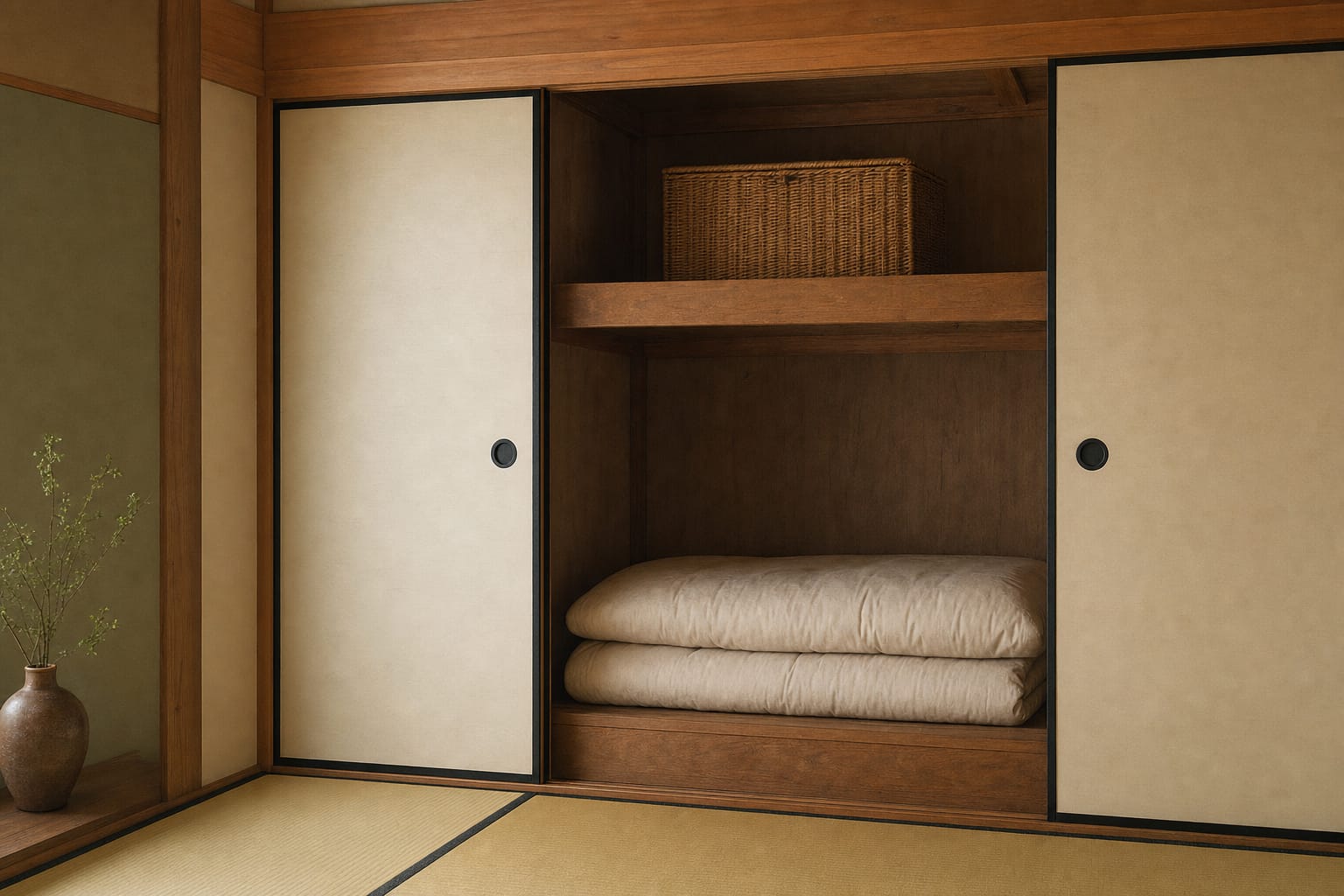
Every Japandi moodboard has a photo of one perfect open shelf — three ceramic bowls, one branch in a vase, nothing else. Nobody ever photographs the closet, which is a little strange, because the closet is doing more of the actual work than the shelf is. In a Japanese apartment there usually isn’t much of one to photograph anyway.
The short answer: the traditional storage unit is the oshiire — a closet roughly the size of one tatami mat, split by a shelf across the middle into an upper half and a lower half, closed off with sliding fusuma doors instead of a hinged one. It was built to hold the futon during the day so the room underneath could be used for something else. That one job — store what’s not in use right now, free the floor for what is — is the whole principle Japandi storage is trying to borrow. Below is what that looks like translated into a closet you already own.
What an oshiire is actually doing
A Western closet is sized around what you own. An oshiire is sized around what’s in rotation. The futon goes in every morning and comes out every night; off-season blankets live on the high shelf and get swapped out twice a year; nothing in there is meant to sit untouched for a decade. The closet isn’t bigger because the house doesn’t need it to be — rotation does the work that square footage does in a Western closet.
This is also where the twice-yearly clothing swap, koromogae, comes from. It’s a real custom, not a lifestyle-blog invention: the Heian-era imperial court was already changing robes by season over a thousand years ago, the Tokugawa shogunate made samurai do it four times a year during the 1600s, and the Meiji government settled it into the June 1 and October 1 dates that Japanese schools and offices still half-follow today. The point was never the date itself. It was that off-season clothing gets stored somewhere else entirely, so the closet in daily use only ever holds what the current month needs.
New-build Japanese apartments mostly don’t have real oshiire anymore — what you get instead is a slim reach-in closet, often not much deeper than a coat is wide. Japanese home design still plans storage as a fixed share of the floor plan, commonly cited at somewhere around 10 to 15 percent of total floor area. Most Western house plans don’t budget storage as a percentage of anything. The closet is whatever’s left after the rooms are drawn.
Why the guest futons live in there
A lot of Japanese households keep a spare set of futons on hand for guests, even in homes where everyone sleeps in beds now. When relatives come to stay, nobody goes out to buy an air mattress — the futons come out of the oshiire, get laid on the tatami for the night, and go back in the next morning.
That’s the oshiire doing exactly what it was built for: holding something you need a few nights a year, so the room can be a living room the rest of the time.
The ranked list
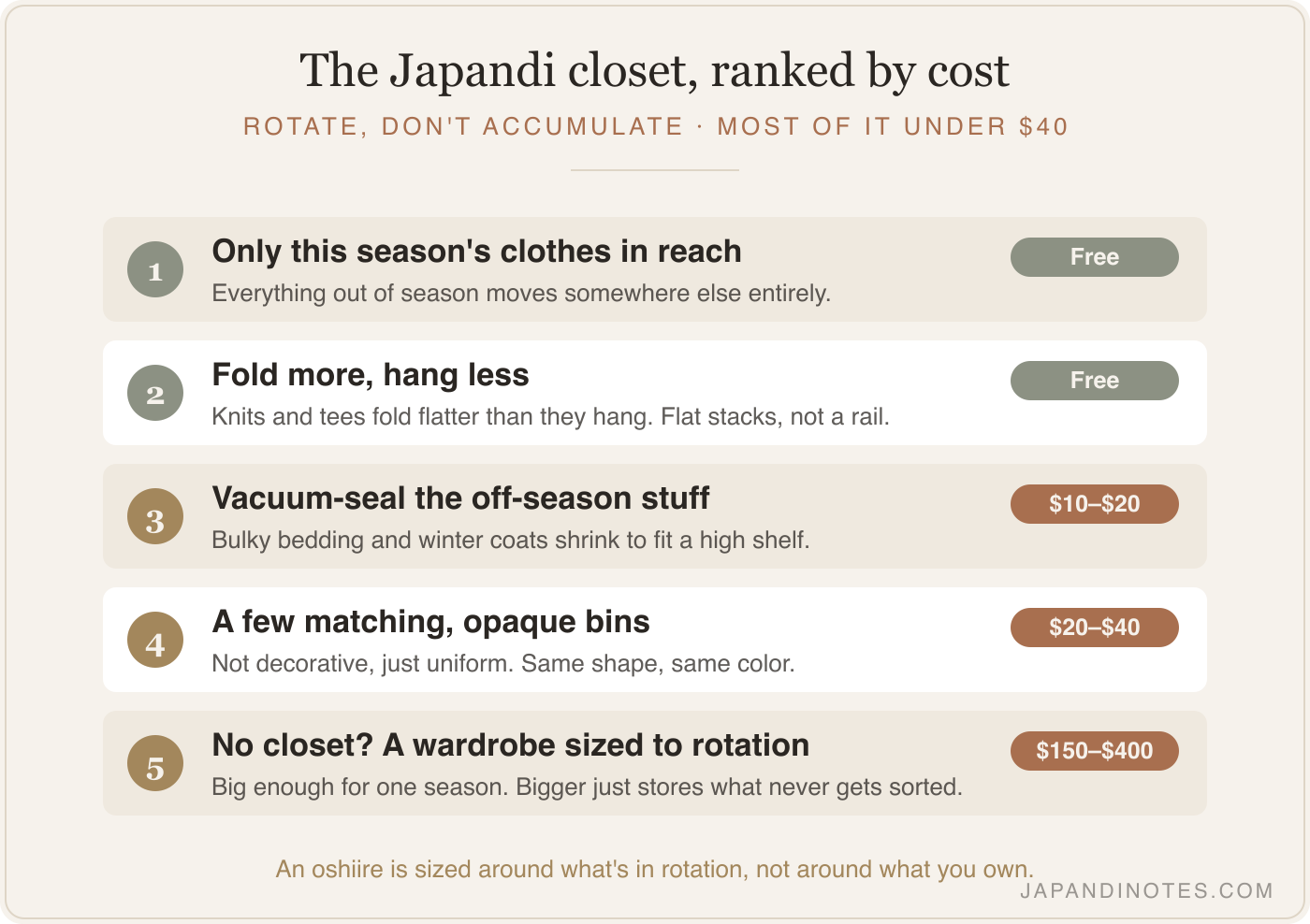
1. Only keep this season’s clothes within reach. Free. The single biggest change, and it costs nothing because it’s a sorting decision rather than a purchase. Everything out of season moves somewhere else entirely — under the bed, in a suitcase on a high shelf, or wherever else you’ve got room that isn’t this closet. What’s left in daily reach should be roughly a season’s worth of clothing, with eight more months of it not sitting there taking up hanger space it doesn’t need yet.
2. Fold more, hang less. Free. Hanging is a Western default, not a storage requirement. Sweaters, T-shirts, and anything knit fold flatter and store denser than they hang, and folding is most of what an oshiire shelf is designed around in the first place: flat stacks instead of vertical space. If you’ve come across Marie Kondo’s standing fold, it makes more sense in this light — less a tidying trick than a way of folding something to fit a shelf instead of a rail.
3. Vacuum-seal the off-season stuff, $10–$20 for a small pack. Bulky bedding and winter coats are the two things that make an off-season box too big to store anywhere convenient. A vacuum bag solves that by compressing them to a fraction of the size — the closest thing a Western home has to the way a folded futon disappears into an oshiire shelf. They do lose their seal eventually, usually after a few years of use, so don’t buy them expecting a lifetime fix.
4. A few matching, opaque storage bins, $20–$40. Not decorative — just uniform. A shelf of five different cardboard boxes and two tote bags reads as clutter even when it’s organized; the same five boxes in one color and one shape read as storage. This is the cheapest “instant calm” move on this entire list.
5. If you have no closet at all: a wardrobe sized to what’s in rotation, $150–$400. Skip the walk-in fantasy and the full dressing-room system — a single freestanding wardrobe sized for the current season’s clothes does the job, with everything else living in the vacuum bags from #3. Buying a bigger wardrobe than that just gives the off-season clothes somewhere convenient to never get sorted.
What not to bother with
Skip the modular closet system — the kind with the drawer inserts and the adjustable shelving grid, sold as one coordinated unit for $800 and up. It’s solving a problem that rotation already solves for free, and most of the inserts end up holding things that shouldn’t have been kept in the first place. I’d rather see someone spend that $800 on literally anything else in the room.
Skip cedar balls and scented sachets for “that fresh closet smell” too. A closet that needs active deodorizing usually just needs fewer things stuffed into it and a door that gets opened more than twice a month. Masking the smell never actually fixes what’s causing it.
Where I still get this wrong
I own a coat I bought four winters ago and have worn maybe six times, and every October it goes back into the main closet instead of the vacuum bag with the rest of the winter things, because some part of me insists this is the year I wear it properly.
It isn’t. It takes up a hanger that a coat I actually wear could use, every single winter, and I know this, and I do it anyway.
The honest fix isn’t a better bin. It’s admitting the coat should go to a donation bin instead of a storage one — which is a harder sentence to act on than it is to write. Start with #1 and #2 this weekend; they cost nothing and take about twenty minutes. The wardrobe can wait for payday.
— Sen
For anyone working through other overlooked rooms the same way: the entryway runs on the same cheapest-fix-first logic as this closet does, the bedroom’s version of rotation over accumulation is why the floor stays empty and the bed sits low, renters dealing with a closet they can’t modify at all should start with what actually survives a security deposit, and the bigger idea behind all of it — storing less instead of storing better — is laid out in what real Japanese homes actually look like.

From our print shop
Wall art, made with this palette
Two collections built on the exact five colors from this site — watercolor landscapes and sumi-e botanicals. Instant download, five print sizes per artwork.
See all the prints →The 5 Japandi Principles (Free Cheat Sheet)
The five ideas that actually transfer from real Japanese homes — printable, one page, free.
Get the cheat sheet →