Rooms
The Japandi Genkan: Fixing the Entryway Every Guide Forgets (Most of It Under $30)
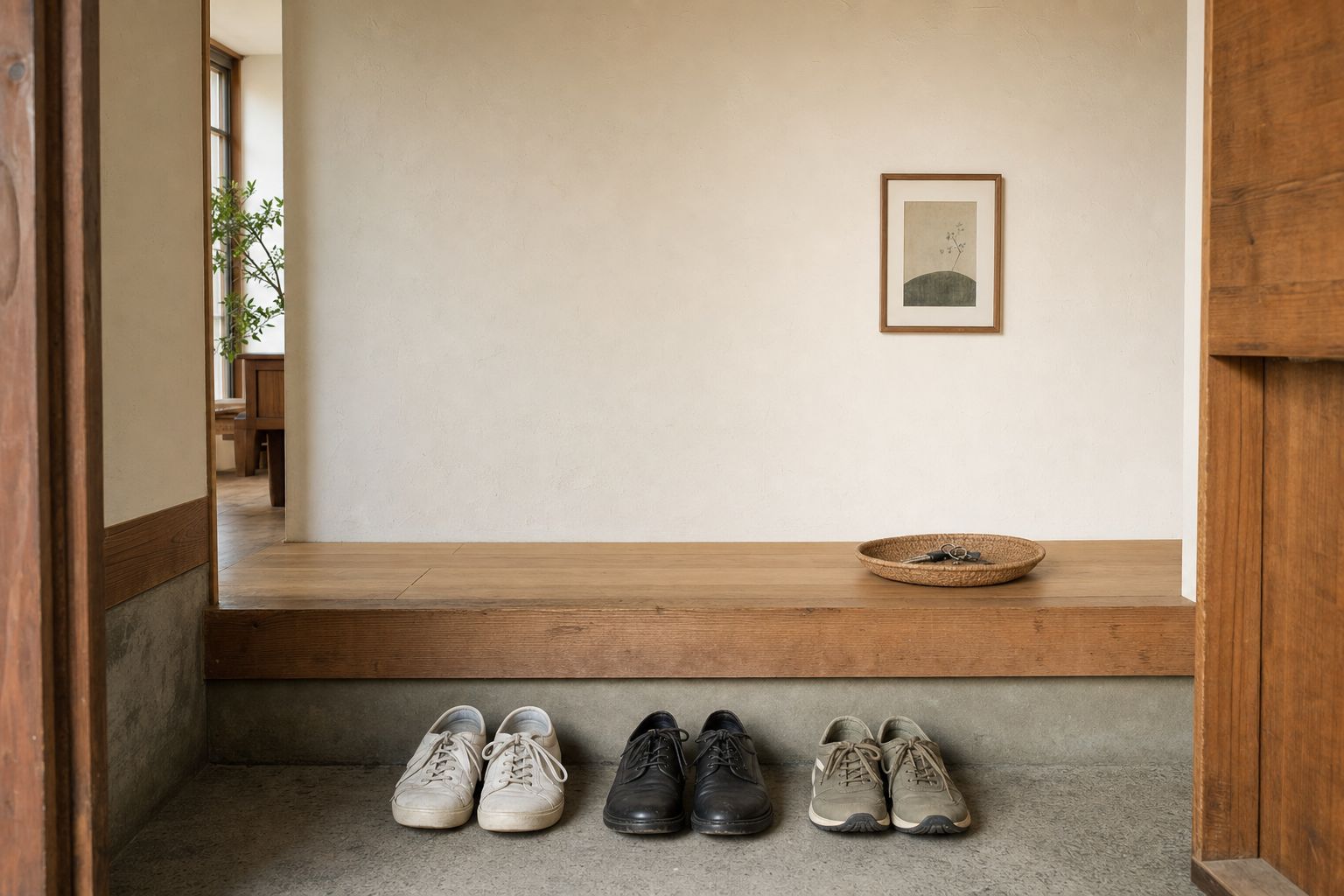
Search any Japandi moodboard and you’ll find eleven photos of the living room, four of the bedroom, and approximately zero of the entryway. Which is strange, because in an actual Japanese home the entryway is the room with the most rules. It’s also the one you can fix this weekend for less than a nice dinner out.
The short answer: a genkan is a sunken entry floor — the tataki — set 10 to 20 centimeters below the rest of the house, where shoes come off before you step up onto the raised main floor. That step (the agarikamachi) is the whole trick: it draws a hard line between outside-dirty and inside-clean, and everything that makes a genkan feel calm follows from respecting that line — buying something expensive doesn’t substitute for it. Below: what the line actually requires, ranked from free to worth spending on.
What a genkan is actually doing
Most Western entryways are a doormat and a coat hook bolted onto whatever space was left over near the front door. A genkan is a room with a job: it’s the only part of a Japanese home where the outside world is allowed in, and its entire design exists to stop that world from going any further than it has to.
That’s why the step matters more than the decor. Lower than the house by less than a foot, just enough that removing your shoes there feels like an event rather than an afterthought. You don’t need a real step to borrow the idea — you need a floor that visibly says “outside stuff stays here.”
The habit that costs nothing
Here’s the one I actually got wrong for years before my wife’s family, without ever saying a word about it, fixed it for me.
The first time I stayed at my in-laws’ place in Tango, up on the Kyoto coast, I kicked my shoes off at their genkan and walked straight up without turning them around. Hours later, coming back through, my sneakers were already sitting there facing the door, toes out, ready to step into. Nobody had mentioned it. It took me until my third visit to actually notice that my mother-in-law was the one doing it, every single time, without comment.
That’s the custom: shoes get turned so the toes point toward the door, which means whoever’s leaving can just step into them instead of shuffling around backward. It costs nothing and takes four seconds. If you do only one thing from this article, do this one — tonight, at your own front door.
The ranked list
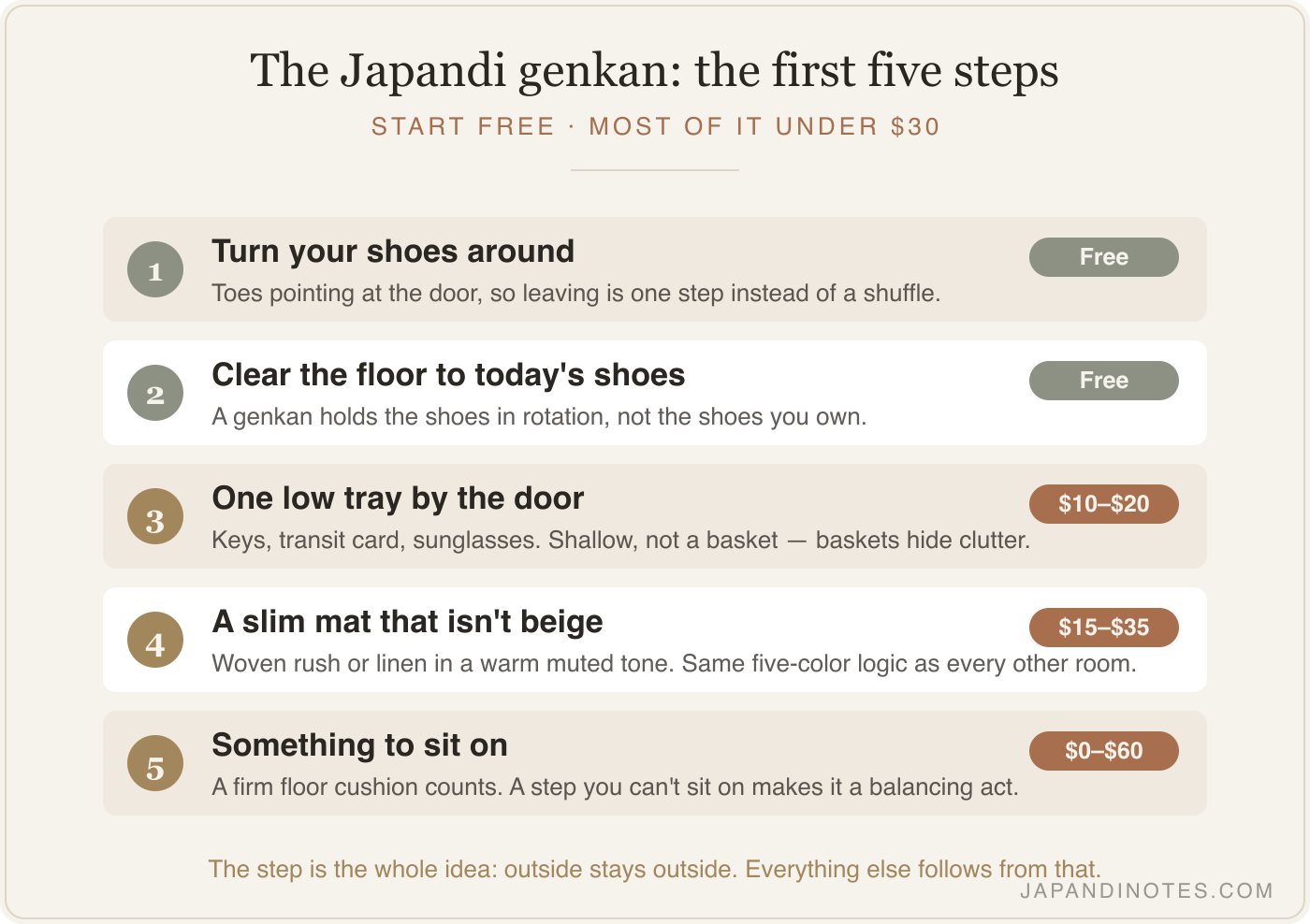
1. Turn your shoes around. Free. Covered above. The single highest-impact habit in this entire piece, and the only genuinely un-skippable one.
2. Clear the floor down to what you’re wearing today. Free. A genkan holds the shoes in rotation, not the shoes you own. Everything else goes in a cabinet, a closet, anywhere out of sight. A floor with six pairs scattered across it reads as clutter no matter how nice the shoes are.
3. One low tray by the door, $10–$20. Keys, a transit card, sunglasses — the small stuff that otherwise migrates to every counter in the house. A shallow wooden or woven tray does this; a ceramic dish works too. The point isn’t the material, it’s that there’s exactly one approved landing spot.
4. A slim mat that isn’t beige, $15–$35. Most entryway mats are gray-brown so stains don’t show, which is also why they look like nothing. A woven rush or linen mat in a warm, muted tone — the same restrained five-color logic that runs through every other room here — does the practical job while actually being something you’d want to look at.
5. Something to sit on, $0–$60. This is the part renters and small apartments usually skip, and it’s a mistake — a step you can’t sit on turns “take your shoes off” into a one-legged balancing act every single time. It doesn’t need to be furniture. A firm floor cushion works. If you want an actual object, a low stool or a narrow bench does what the raised floor does in a real genkan: gives you somewhere to sit while the shoes come off. The same “borrow the step, skip the renovation” move works for renters everywhere in the house, not just here.
6. A shoe cabinet, $60–$120. Getabako, literally “clog box” — a tall, narrow cabinet that holds shoes vertically instead of letting them spread across the floor. You don’t need the built-in version. A slim shoe cabinet from any furniture store does the job as long as it’s taller than it is wide and it closes.
7. One thing on the wall, at standing eye height. $0–$40. This is the only room in the house you experience on your feet and moving through, so wall height rules are different here than in a living room you view from a low sofa. One small print, one hook, one hat — not a gallery. The empty-space principle that shows up everywhere in Japanese rooms applies doubly in a room this small: one object reads as chosen, three objects read as a shelf nobody edited.
What not to bother with
Skip the genkan bench with built-in shoe storage underneath, the one that shows up in every “Japandi entryway” Pinterest board. It’s a fine piece of furniture and a terrible fit for most Western entryways, which are usually just a doorway with a coat closet nearby — you’ll spend $300 on something that needs four feet of floor space most apartments don’t have near their front door.
Skip the motion-sensor entryway light too. It solves a problem a $4 warm bulb and a switch you remember to flip already solves, and the sensor version has a way of clicking on at 2 a.m. when you’re just walking past on the way to the kitchen.
And don’t buy a matching shoe rack, coat rack, and umbrella stand as a set. My in-laws’ genkan has a shoe cabinet that’s older than my wife, an umbrella stand from a hundred-yen shop, and a coat hook that’s just a nail. None of it matches. All of it works, because each piece was chosen for one job instead of for looking like it belongs with the others.
Where I still get this wrong
I’ll admit the tray idea took me two tries. I bought a deep basket first, thinking it would hold more, and it immediately became a junk drawer with the lid off — receipts, a dead phone charger, one glove with no pair. A shallow tray forces the opposite behavior: there’s no room to hide clutter, so you either put the thing away properly or you notice it sitting there and deal with it. I swapped baskets within a month.
None of this needs a contractor or a landlord’s permission. Start tonight with the shoes — turn them toward the door before you go to bed — and add the tray this weekend. The cabinet can wait for payday; the four seconds it takes to turn a pair of shoes around can’t really be improved on at any price.
— Sen

From our print shop
Wall art, made with this palette
Two collections built on the exact five colors from this site — watercolor landscapes and sumi-e botanicals. Instant download, five print sizes per artwork.
See all the prints →The 5 Japandi Principles (Free Cheat Sheet)
The five ideas that actually transfer from real Japanese homes — printable, one page, free.
Get the cheat sheet →