Rooms
The Japandi Living Room: What to Keep When You Take the Sofa Away
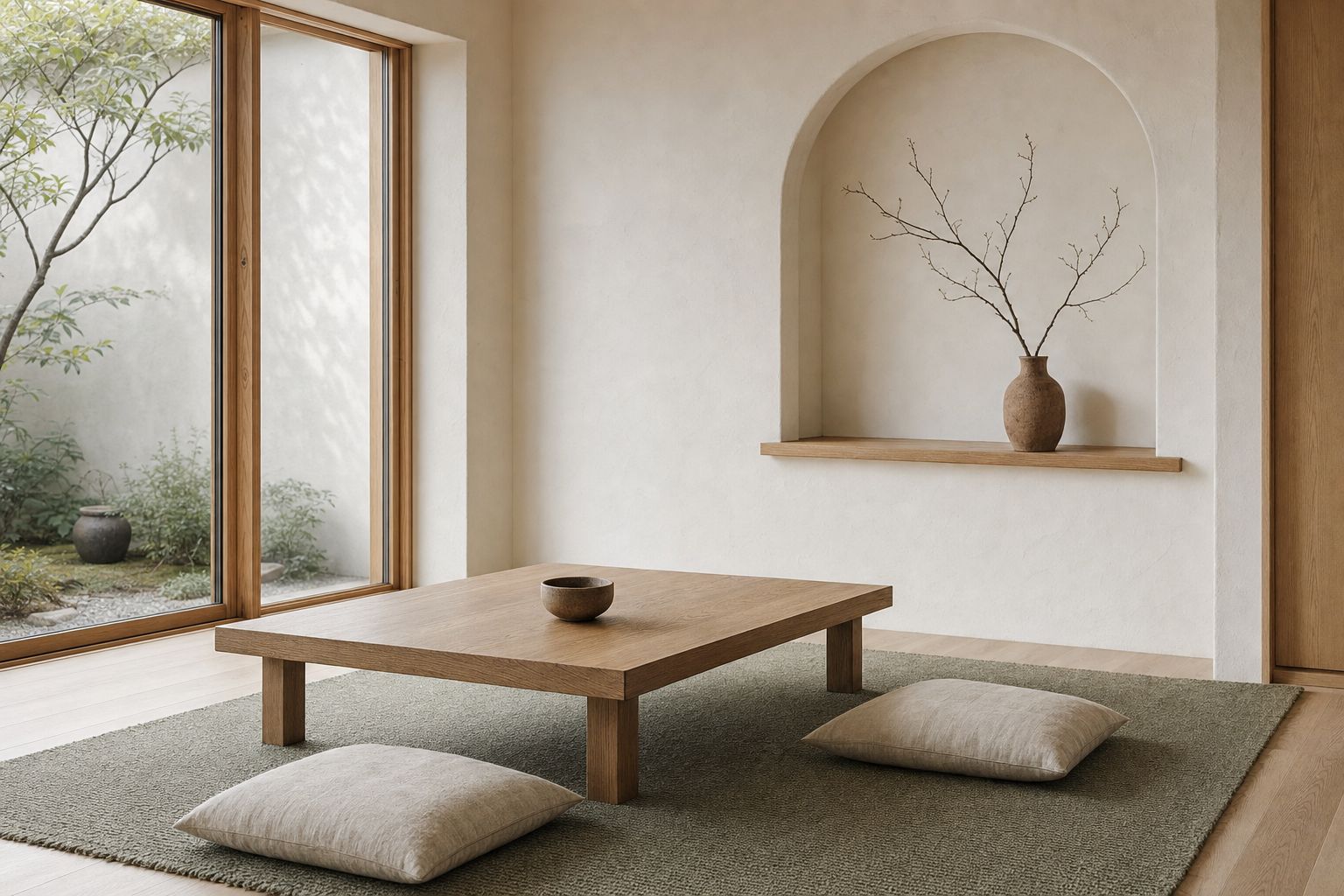
Every Japandi living room photo you’ve saved has a sofa in it. A low one, usually, in bouclé or linen, doing the same job a sofa does in any Western room: the piece everything else is arranged around. Here’s the thing nobody selling that photo tells you — a lot of actual Japanese living rooms aren’t arranged around a sofa at all. Ours wasn’t, for the first two years we lived here.
That’s not a minimalism flex. It’s what happens when the room also has to become a guest bedroom twice a year and nobody wants to move a three-seater to do it.
The room is doing more jobs than a Western living room
My in-laws’ house is on the Tango peninsula, on the Kyoto side of the coast that tourists mostly skip for the temples inland. Their living room has a low table, a set of floor cushions stacked in the corner, and a single cupboard where a futon lives folded up for most of the year. When relatives come to stay, the table gets pushed against the wall, the futon comes out, and the living room is a bedroom by nine p.m. That’s not a stylistic choice — it’s what a room does when the house doesn’t have a spare one for guests.
That flexibility is the actual root of the Japanese living room, more than any aesthetic principle. Furniture that can’t be moved by one person doesn’t belong in a room that has to change jobs. A sofa, once you’ve bought it, mostly can’t. A low table and a stack of cushions can, in under a minute.
What actually replaces the sofa
Not nothing — three things, roughly in order of how much weight they carry.
A low table, always. Not a coffee table in front of a sofa — the table is the center, at a height you can sit at directly on the floor or on a cushion. Everything else in the room refers back to it.
Floor cushions (zabuton) instead of armchairs. They stack, they store flat, and unlike a chair they don’t claim a fixed spot on the floor plan. A pair costs less than one throw pillow from a Western home store and does more actual sitting duty.
One alcove or shelf, kept nearly empty. In a traditional room this is the tokonoma — a shallow built-in recess, traditionally about one ken wide (roughly 1.8 m) and half that deep, holding one hanging scroll and one seasonal object and nothing else. Most rental apartments don’t have a real tokonoma anymore, but the instinct survives as one shelf that stays almost bare on purpose. It’s the same ma — the deliberate empty space — we’ve written about elsewhere on this site, just relocated from a temple alcove to an Ikea Kallax.
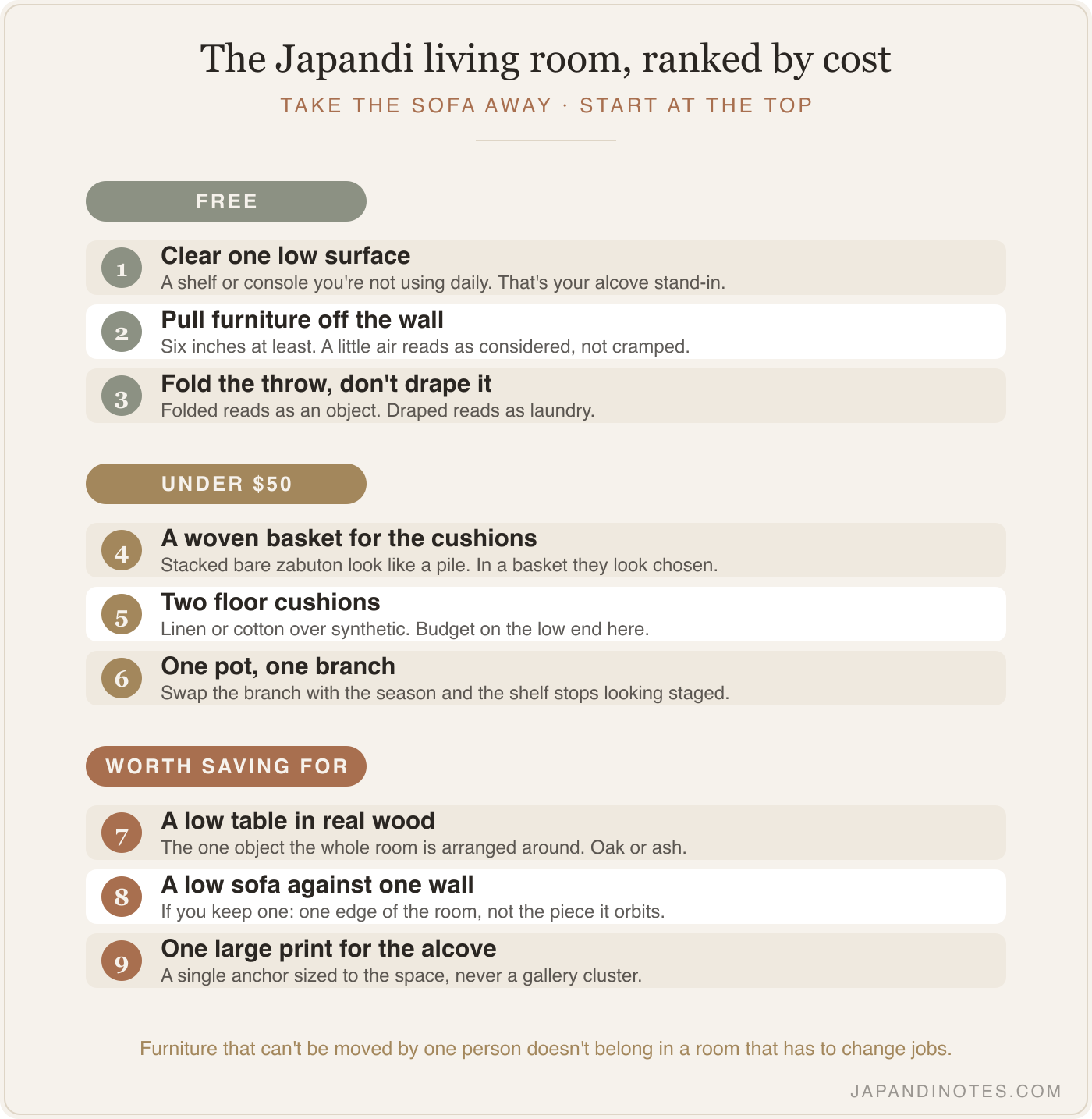
Ranked by cost
Free
- Pick one low surface and clear it completely. Not the coffee table you eat off — a second one, a shelf or console you’re not using daily. That’s your alcove stand-in.
- Pull the furniture off the walls, six inches at least. Japanese rooms rarely push everything to the perimeter the way Western rooms do; a little air behind each piece reads as considered rather than cramped.
- Fold the throw blanket instead of draping it. A small thing, but a folded textile reads as an object; a draped one reads as laundry that didn’t make it to the hamper.
Under $50
- A rattan or rush-woven storage basket for the cushions. Stacked bare zabuton look like a pile; the same cushions in a woven basket look chosen. This is the same texture-over-color move that runs through the whole palette.
- Two floor cushions, linen or cotton over anything synthetic. Budget on the low end here — this isn’t the room’s expensive object, it’s the flexible one.
- A single ceramic or unglazed pot for the alcove shelf, with one branch in it. Swap the branch with the season and the whole shelf stops looking staged.
Worth saving for
- A low table in real wood, not a laminate coffee table on short legs. This is the one object the whole room is arranged around, so it’s the one worth the extra spend. Oak or ash keeps it inside the five-color palette without any extra thought.
- If you keep a sofa, make it low and legless-looking, and put it against one wall only. A sofa doesn’t have to disappear — ours came back in year three, once the kids stopped needing the floor space — but it works better as one edge of the room than as the piece everything orbits.
- One large print or hanging scroll for the alcove wall, sized to the space, not a gallery cluster. A living room gets one strong anchor rather than the grid treatment that works over a bench or bed — the alcove logic wants a single object, and our own printable sets include single large pieces sized for exactly this.
The kotatsu question
Anyone who’s spent a winter here has an opinion about kotatsu — the low table with a heater built into the frame and a heavy blanket trapped under the tabletop, so your legs sit in a warm pocket while the rest of the room stays cold. A bare-bones table-and-heater unit at a home store like Nitori starts around ¥5,000–¥8,000, and a fuller set with a proper blanket and a nicer top commonly runs ¥25,000 or more.
It is, without question, the coziest object in this entire list, and I’d tell you to buy one immediately except that it solves a problem most Western homes don’t have: central heating means you’re not choosing between heating one table or the whole room. Where it does make sense outside Japan is anywhere with a drafty floor and a low tolerance for the heating bill — a converted garage, a sunroom, a cabin. Everywhere else, it’s a lovely novelty that becomes a table you can’t easily move once the cord is involved. I wouldn’t rank it in the cost ladder above for that reason; it’s less a Japandi furniture piece than a genuinely Japanese winter habit, and it deserves its own honest write-up rather than a line item here.
What not to buy
The matching “Japandi living room set” — sofa, coffee table, side table, media console, all in the same pale oak, all bought in one order. It photographs as a showroom because it is one; nothing in it was chosen against anything else. My in-laws’ living room has furniture from three different decades in it and it works precisely because none of it is trying to match — the low table is old, the cushion covers are new, the cupboard was somebody’s grandmother’s. What holds it together is a consistent tone, never a matching shopping cart.
Skip the sectional, full stop, regardless of budget. A room that might need to become somewhere to sleep, or fold flat for a Sunday when six people are visiting, can’t afford a piece of furniture that only does one job in one fixed spot.
Start with the alcove shelf and the six inches of air behind your furniture — both cost nothing and take an afternoon. The low table can wait for the next paycheck; the room will already feel less like a showroom by dinner.
— Sen

From our print shop
Wall art, made with this palette
Two collections built on the exact five colors from this site — watercolor landscapes and sumi-e botanicals. Instant download, five print sizes per artwork.
See all the prints →The 5 Japandi Principles (Free Cheat Sheet)
The five ideas that actually transfer from real Japanese homes — printable, one page, free.
Get the cheat sheet →