Rooms
The Japandi Kitchen: Why the Smallest Room in the House Works So Well
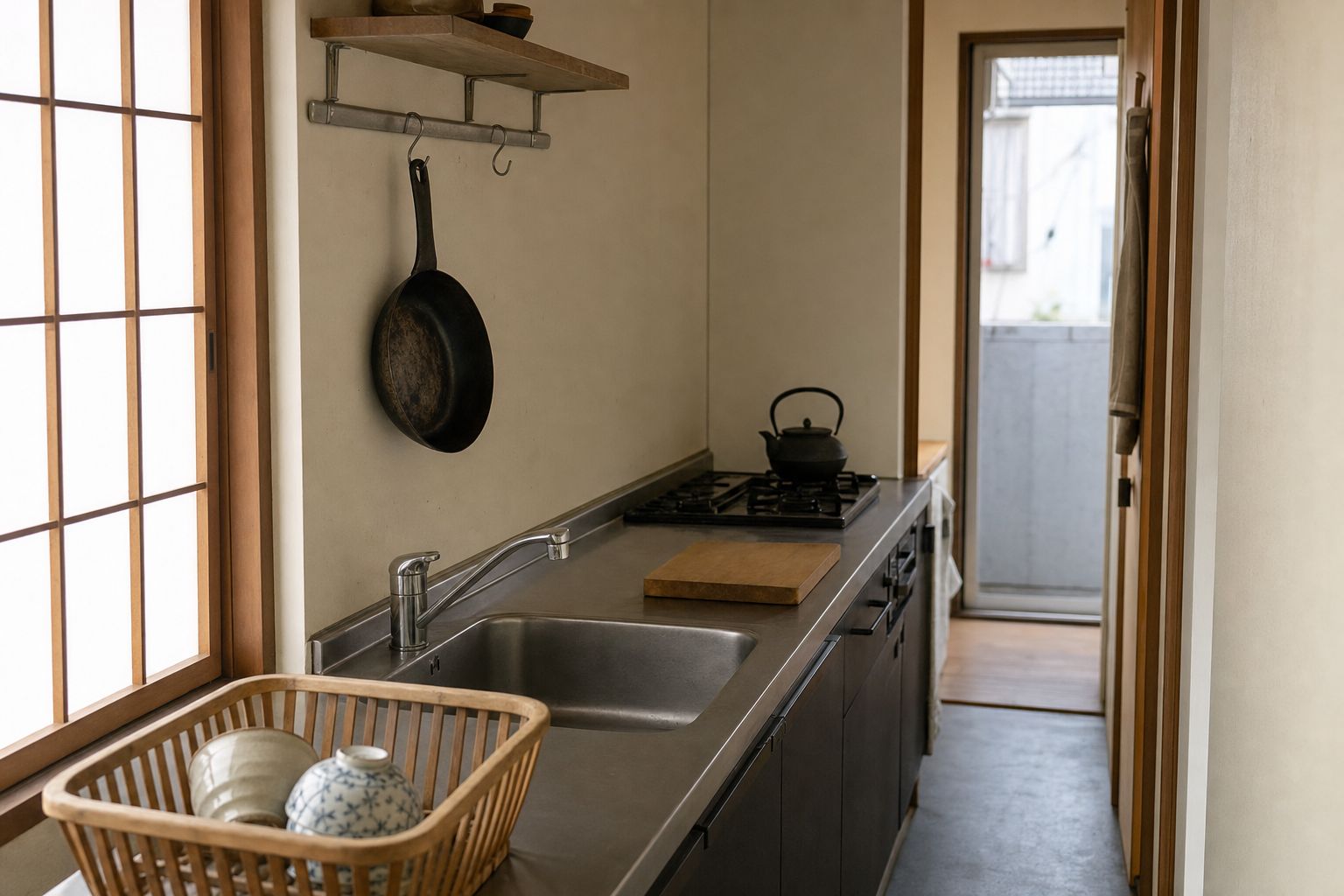
Search “Japandi kitchen” and you’ll get the same photo forty times: a six-foot marble island, brass fixtures, one perfect ceramic bowl doing nothing on an acre of counter. It’s a beautiful picture. It also has almost nothing to do with an actual Japanese kitchen, which is usually closer in size to a hallway than a room.
Here’s the part nobody selling that island wants you to know: the calm isn’t coming from the space. It’s coming from how little is asked of it.
That’s the whole trick.
The kitchen you’re picturing doesn’t exist here
A 1K apartment — the standard starter unit for a single person in Tokyo — runs about 20 to 30 square meters, kitchen included. Land is expensive and buildings are dense, so the kitchen is usually the room nobody fights to enlarge; it gets whatever’s left after the bedroom and the bath claim their share. What’s left is frequently a single wall: sink, two-burner stove, and a strip of counter you could fit a cutting board on and not much else. Real estate listings call this a “system kitchen,” which sounds impressive and just means the whole run of it comes pre-built as one sealed unit rather than assembled from separate purchases.
One detail that surprises people every time: the stove usually has a narrow drawer-grill built into its base, sized for cooking a single fish whole under direct heat. It’s the one piece of genuinely specialized equipment in an otherwise minimal kitchen, and it tells you something. Japanese kitchens aren’t minimal because nobody cares about food. They’re built for a specific, repeated set of tasks, and nothing outside that set earns counter space.
My grandparents’ kitchen was like this — barely wider than the hallway leading into it, a single gas ring by the window, and a wooden mizukiri kago (a slatted drainer basket) sitting permanently on the drainboard because there was no dishwasher to hide the dishes in between meals. Whatever tea I was handed there came out of an iron kettle kept in view on that same narrow strip of counter — there was no cupboard full of small appliances to put it away in. It was, by any American measure, a tiny and underequipped kitchen. It was also one of the most functional ones I’ve ever cooked in, because everything in it had a reason to be sitting exactly where it was.
The fridge plays into this too, and it’s usually smaller than what a two-person American household would consider normal. Part of that is simply the apartment — there’s nowhere to put a side-by-side — but part of it is that grocery shopping here tends to happen in smaller, more frequent trips rather than one large weekly haul. A kitchen built to hold three days of food instead of two weeks of it doesn’t need the storage a bigger fridge implies, and that shrinks the whole footprint of the room around it. It’s a supply-chain habit as much as a design choice, but the effect on the kitchen is the same either way: less needs to be stored, so less has to be built to store it.
What actually makes it feel calm
Not the size. Not the finishes. Three things, in order of how much they matter:
Almost nothing lives on the counter. Not “styled to look empty” — actually empty, because there isn’t room to store the toaster, the stand mixer, and the fruit bowl on a counter that’s forty centimeters deep. What you use daily is out; what you use monthly lives behind a door.
Storage is vertical, not deep. Shallow, high shelves instead of deep cabinets you have to excavate. You can see everything you own at a glance, which does something to how cluttered a kitchen feels independent of how much is actually in it.
Nothing is duplicated. One good knife instead of a block of twelve. One pot that goes straight from the stove to the table. This isn’t a minimalism aesthetic choice — it’s what happens when a kitchen genuinely doesn’t have the square footage for a spare of anything.
You’ll also never find a garbage disposal under a Japanese kitchen sink. They’re essentially absent from Japanese apartments, partly because of how the local sewage systems were built and partly because food waste already has its own separated collection day. Everyone just… has a strainer basket in the drain instead. It’s a small thing, but it’s the kind of detail that makes a real kitchen look different from a rendering. The same gap between the trend and the source material turns up in every room we’ve written about — the kitchen is just the room where it’s easiest to prove.
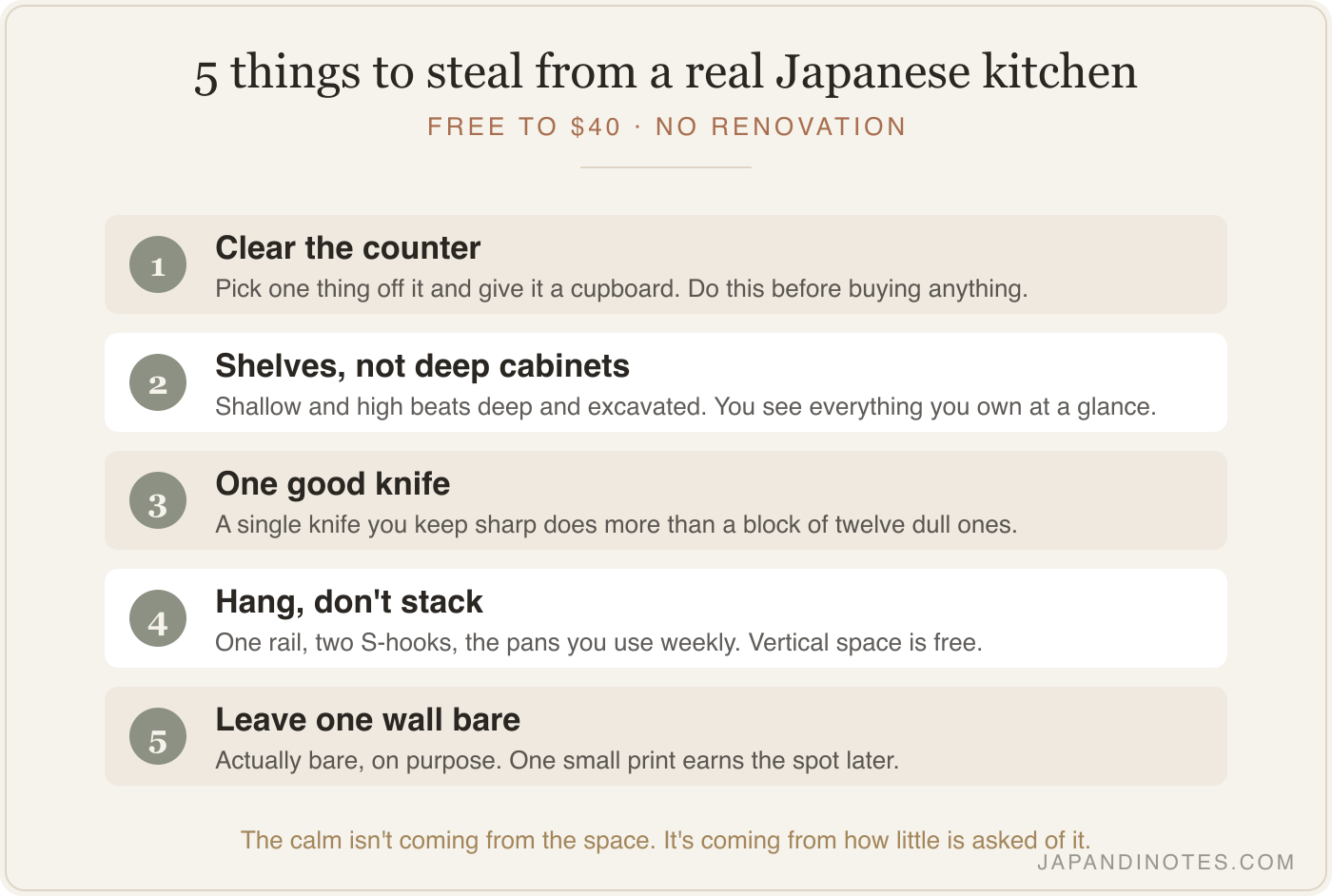
Five things to steal, free to $40
-
Pick one thing off the counter and give it a cupboard. The coffee grinder, the cutting board, whatever’s been sitting out since you moved in. Do this before buying anything else on this list.
-
Buy a proper drying rack instead of grabbing whatever’s cheapest. A slatted wooden or bamboo mizukiri kago sized to your sink turns into furniture you don’t mind leaving out, rather than a plastic eyesore you hide when guests come over. It’s also the fastest way to make peace with not owning a dishwasher.
-
Consolidate to one good knife. If you’re staring down a twelve-piece block, this is your permission to donate eleven of them. A single knife you actually keep sharp does more work than a drawer of dull ones — the same “fewer, better” logic runs through every room on this site, the kitchen included.
-
Hang instead of stacking. A single rail with S-hooks for the two or three pans you use weekly. Vertical space is free; counter space isn’t.
-
Leave one wall genuinely bare. Not styled-bare — actually bare, on purpose, the way a rental kitchen with nothing on the wall to begin with can still read as intentional rather than unfinished. When you’re ready to put something there, one small print earns its spot better than a shelf of decorative jars — that’s most of why our own printable sets are sized for exactly one narrow strip of wall.
What not to bother with
Skip the garbage disposal install. It solves a problem Japanese kitchens don’t have and American ones mostly don’t either — a strainer basket and a weekly trip to the compost bin does the same job for free. And skip the matching 20-piece dinnerware set while you’re at it; a real Japanese cupboard has mismatched bowls collected over years, not a boxed set from a showroom.
I’ll admit I got the drying rack step wrong myself the first time. I bought a big two-tier one because it looked efficient in the store, and it ended up blocking half the window above my sink for two months before I finally measured the counter and swapped it for something a third the size. Smaller was correct. It’s usually correct.
None of this requires a renovation. Most of it requires a Saturday morning and the willingness to put eleven knives in a donation box. Start with the counter — clear it once, and you’ll notice within a week how much less the whole kitchen asks of you.

From our print shop
Wall art, made with this palette
Two collections built on the exact five colors from this site — watercolor landscapes and sumi-e botanicals. Instant download, five print sizes per artwork.
See all the prints →The 5 Japandi Principles (Free Cheat Sheet)
The five ideas that actually transfer from real Japanese homes — printable, one page, free.
Get the cheat sheet →