Principles
Why Japanese Homes Skip Central Heating (And What They Use Instead)
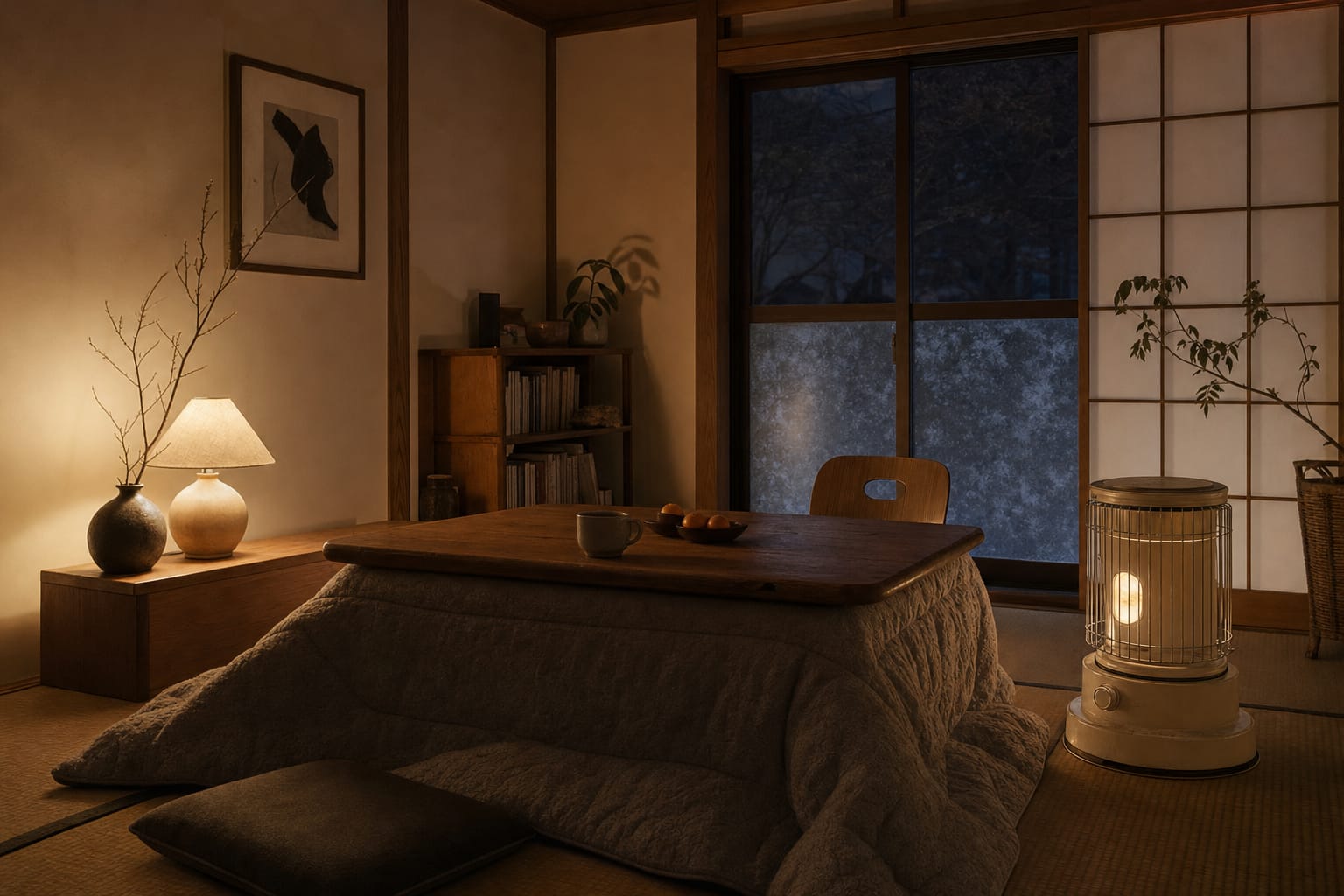
Most people who grow up outside Japan assume a house either has heating or it doesn’t. My parents’ place in Gunma has a kotatsu, like most Japanese homes do, and it still gets properly cold inside in January, because almost no Japanese house is built to fight winter as a whole — it’s built to survive summer, and winter gets handled one room, one body, at a time.
The short answer: most Japanese homes have no central furnace, no ducts, and often no wall insulation worth mentioning, so heating here means warming the room you’re actually in — or just the person — rather than the whole house at once. The tools for that are specific, mostly electric, and cheaper than you’d expect once you stop trying to heat square footage you’re not using.
Why there’s no furnace in the first place
Traditional Japanese house design was built around summer, not winter — wide eaves, sliding paper screens, gaps under the floor, all of it there to let heat and humidity escape in August. None of that was ever retrofitted for January. Add a climate where most of the country, outside Hokkaido and the mountains, gets cold but not brutally cold, and central heating never became the default the way it did in houses built for New England or northern Europe.
Central heating does exist here. It’s standard in big modern buildings, common across Hokkaido, and shows up as underfloor heating in some newer condos.
It’s just not something most households have, which means the heater is on you to buy — one more thing a renter has to carry in and take back out when the lease ends.
What actually heats a Japanese room
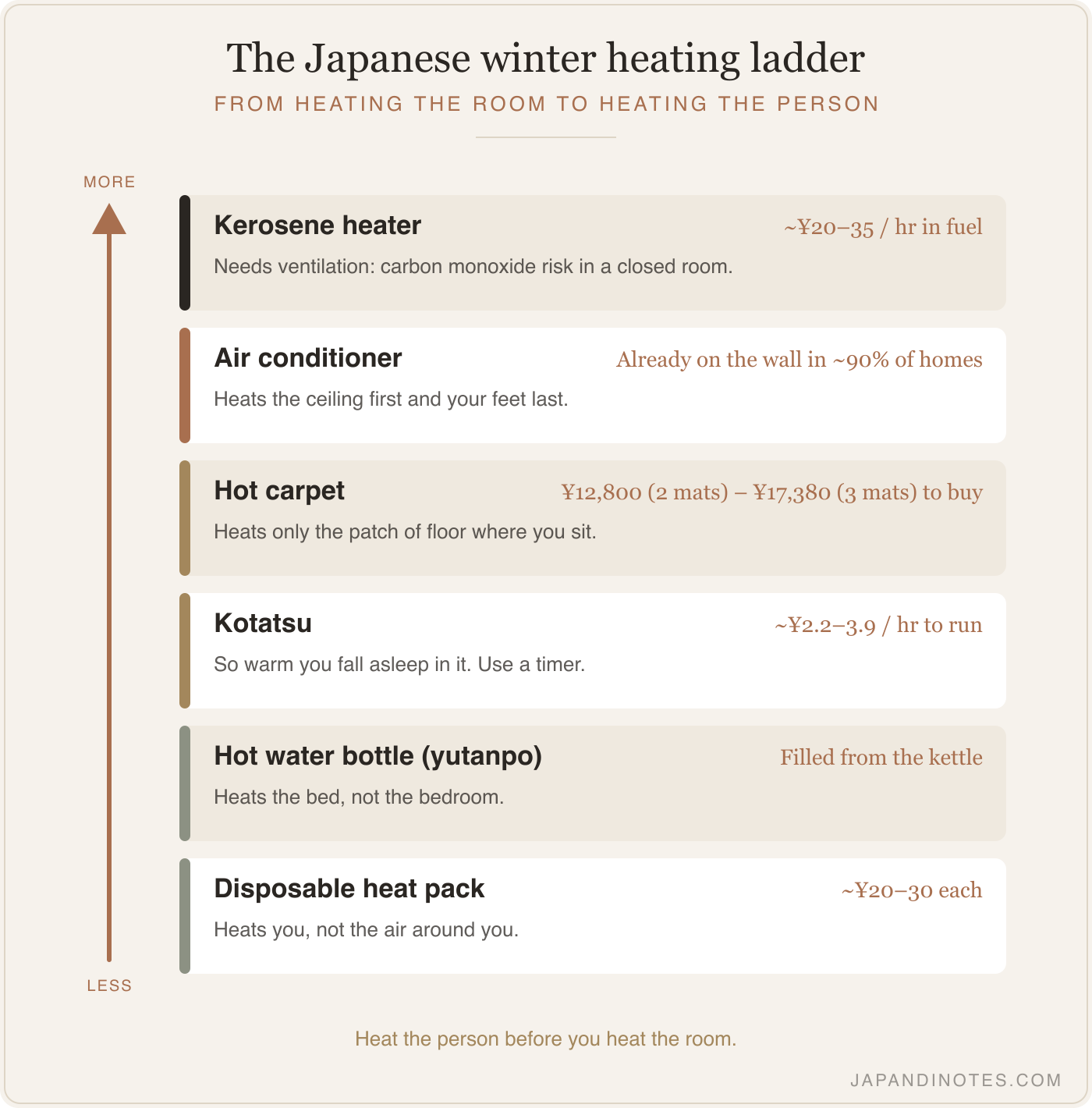
Start with the one appliance almost every household already owns: the air conditioner. Ownership is commonly put at somewhere around 90% of Japanese households, and the heat-pump unit on your wall in summer is the same one blowing warm air in January. It’s also the least controversial option — no fuel to buy, no flame, nothing to ventilate — which is probably why it’s the default even in homes that also keep a kerosene heater for the worst weeks. The one real complaint about it, and it’s a fair one, is that warm air rises: an aircon heats the ceiling first and your feet last, which is exactly the problem every other item on this list exists to solve.
The kerosene heater is the other classic option, and it’s still common enough outside Tokyo that you’ll recognize the brand names — Toyotomi and Corona are the two you’ll see in any home center. They heat a room fast and keep running through a power cut, which is a real advantage in an earthquake-prone country. The tradeoff is the one every manual warns about in bold: the open-flame type burns oxygen as it runs, and using one in a closed room for too long risks carbon monoxide buildup, which is why the instructions tell you to crack a window periodically rather than sealing the room up for the night. Running one for an evening costs somewhere in the range of ¥20 to ¥35 an hour in fuel, depending on the model and the current price of kerosene, plus the mildly annoying errand of refilling the tank from a can instead of just flipping a switch. That ventilation requirement alone is why plenty of renters skip the kerosene heater entirely and just run the aircon through the whole winter instead.
Below that, in both heat output and cost, sits the hardware that actually makes a Japanese winter liveable at floor level. The kotatsu is the most famous of these, with one real design flaw nobody selling you one will mention. Less famous but just as common is the hot carpet, an electric carpet you plug in and sit on top of rather than tucking under anything: Yamazen’s two-tatami-mat version runs about ¥12,800, and a three-mat one is closer to ¥17,380. Roll it out under a low table, add a kotatsu quilt over the top if you want, and you’ve heated the one patch of floor where people actually sit without touching the thermostat for the rest of the apartment.
I’d skip a free-standing electric oil heater here even though every home center sells one. They’re quiet and about as safe as a space heater gets, but they take a genuinely long time to warm a room, which defeats the entire point of a system built around heating one spot fast.
Then there’s the smallest tier, which is really about heating the person instead of any part of the room at all: a yutanpo — a hot water bottle, filled from the kettle and tucked under the covers — a disposable heat pack stuck to the inside of a coat, and a drawer full of heat-retaining base layers that Japanese stores sell by the million every October.
None of it heats a room. All of it is cheaper than running anything with a cord.
The part that takes the most getting used to
If you grew up with a furnace, the adjustment isn’t the heaters themselves. It’s the hallway. Heat the living room properly and the bathroom, the genkan, and the corridor between them stay close to outdoor temperature, so walking from a warm kotatsu to a cold tiled bathroom at 11pm is a genuinely different experience than it is in a centrally heated house. The bathroom itself runs on a similar room-by-room logic — it’s built to be washed down and drained, not kept toasty — so the cold hallway isn’t a design failure so much as the same philosophy showing up somewhere less convenient.
Insulation is the other quiet gap. A lot of the housing stock, especially anything built before the 2000s, has thin single-pane glass and walls with little to no insulation behind them, which is a big part of why the room-by-room approach even makes sense — heating the whole house would mean heating air that leaks straight back out. The cheap fix people actually use here is a plastic insulation sheet pressed onto the window glass, sold at any home center and most 100-yen stores; a small-window kit from a brand like Nitoms runs a couple thousand yen and knocks the edge off the draft without anyone touching the window frame.
What’s actually worth borrowing
If you don’t have central heating either — a drafty rental, an old house, a garage conversion — this is a genuinely well-tested stack, and nobody here is embarrassed about using it. Buy the aircon first; it’s the one tool here with no fuel, no flame, and no ventilation requirement. Add a hot carpet or a kotatsu for the one spot where you actually sit still for hours. Keep the kerosene heater, if you get one at all, for emergencies and short bursts rather than as your main source of heat in a sealed room. And don’t underestimate the disposable heat pack — usually somewhere around ¥20 to ¥30 each at a drugstore — or the hot water bottle; heating yourself instead of the air around you is most of what this whole system is quietly doing anyway.
What I wouldn’t copy is the cold hallway, mostly because you don’t have to. If your house already has ducted heat, there’s no reason to recreate the one part of a Japanese winter that everyone here just tolerates. Take the room-by-room thinking, skip the part where the bathroom is noticeably colder than the living room.
I gave up the kotatsu at home a while back, and what replaced it is a story for a later update to this piece. For now: heat the person before you heat the room, and you’ll spend less than you think.
— Sen
Sources on running costs and ownership rates are estimates from retailer and industry pages rather than a single government survey; treat the yen figures as a reasonable range rather than an exact quote. I’m not a safety inspector — for anything involving an open-flame heater, follow the manufacturer’s own ventilation instructions over anything written here.
If you’re setting up a room from scratch, the living room piece covers what else is worth buying at the same time, and the rental guide has the rest of the “can’t drill into anything” fixes.

From our print shop
Wall art, made with this palette
Two collections built on the exact five colors from this site — watercolor landscapes and sumi-e botanicals. Instant download, five print sizes per artwork.
See all the prints →The 5 Japandi Principles (Free Cheat Sheet)
The five ideas that actually transfer from real Japanese homes — printable, one page, free.
Get the cheat sheet →