Rooms
The Kotatsu: Japan's Favorite Heater, and the One Problem Nobody Warns You About
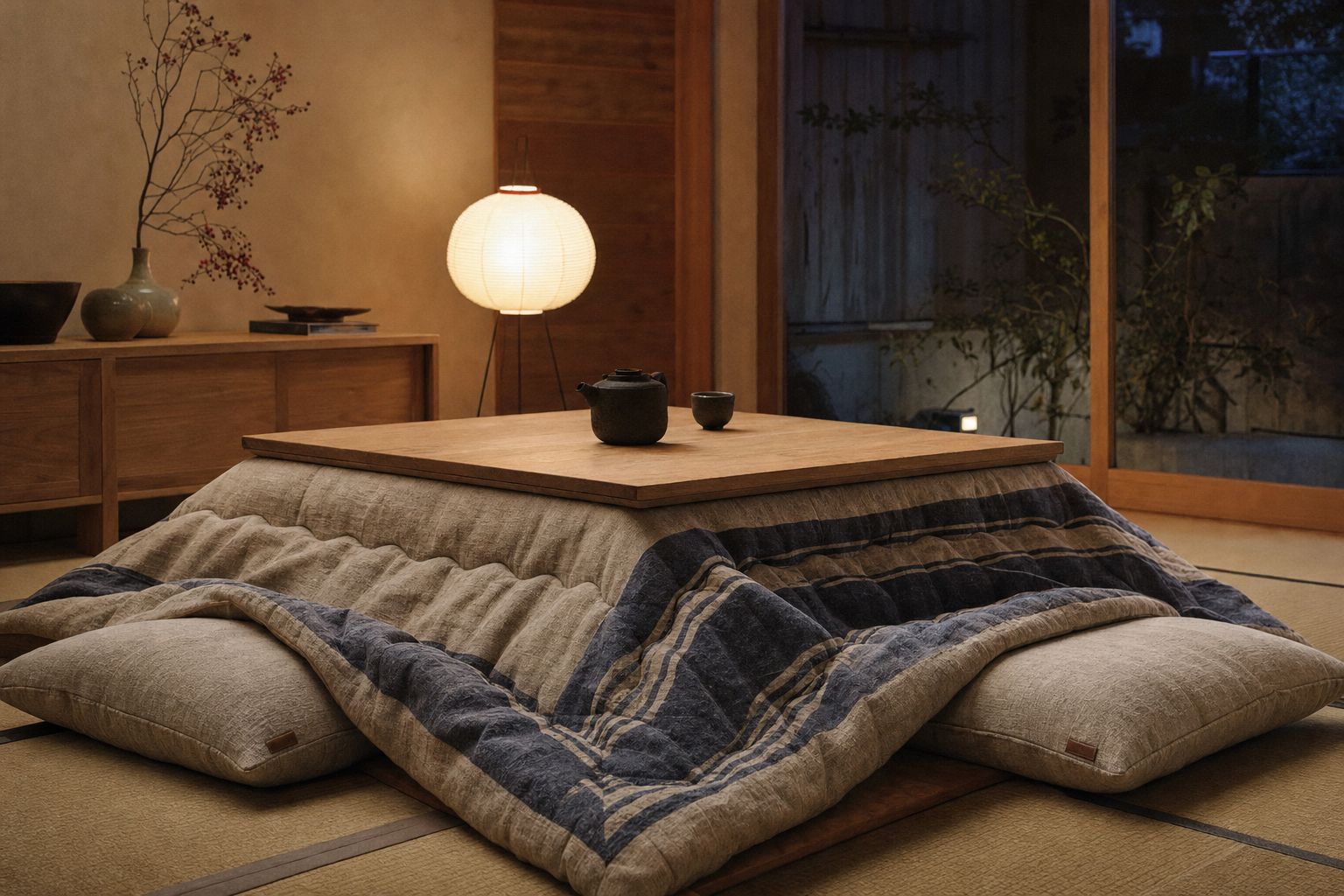
We mentioned the kotatsu once already on this site and then talked ourselves out of covering it properly, on the grounds that it’s less a piece of furniture than a whole Japanese winter habit. That was the right call to defer, and the wrong call to leave it there. So: here’s the honest version, including the part where I don’t actually have one anymore.
The short answer: a kotatsu is a low table with an electric heater mounted under the tabletop and a thick quilt trapped between the frame and the top, so your legs sit in a sealed pocket of warmth while the rest of the room stays whatever temperature it already was. It’s cheap to run, genuinely cozy, and — this is the part the cute photos skip — the thing Japanese people half-jokingly blame every time someone catches a winter cold. Both are true. Neither cancels the other out.
How it actually works
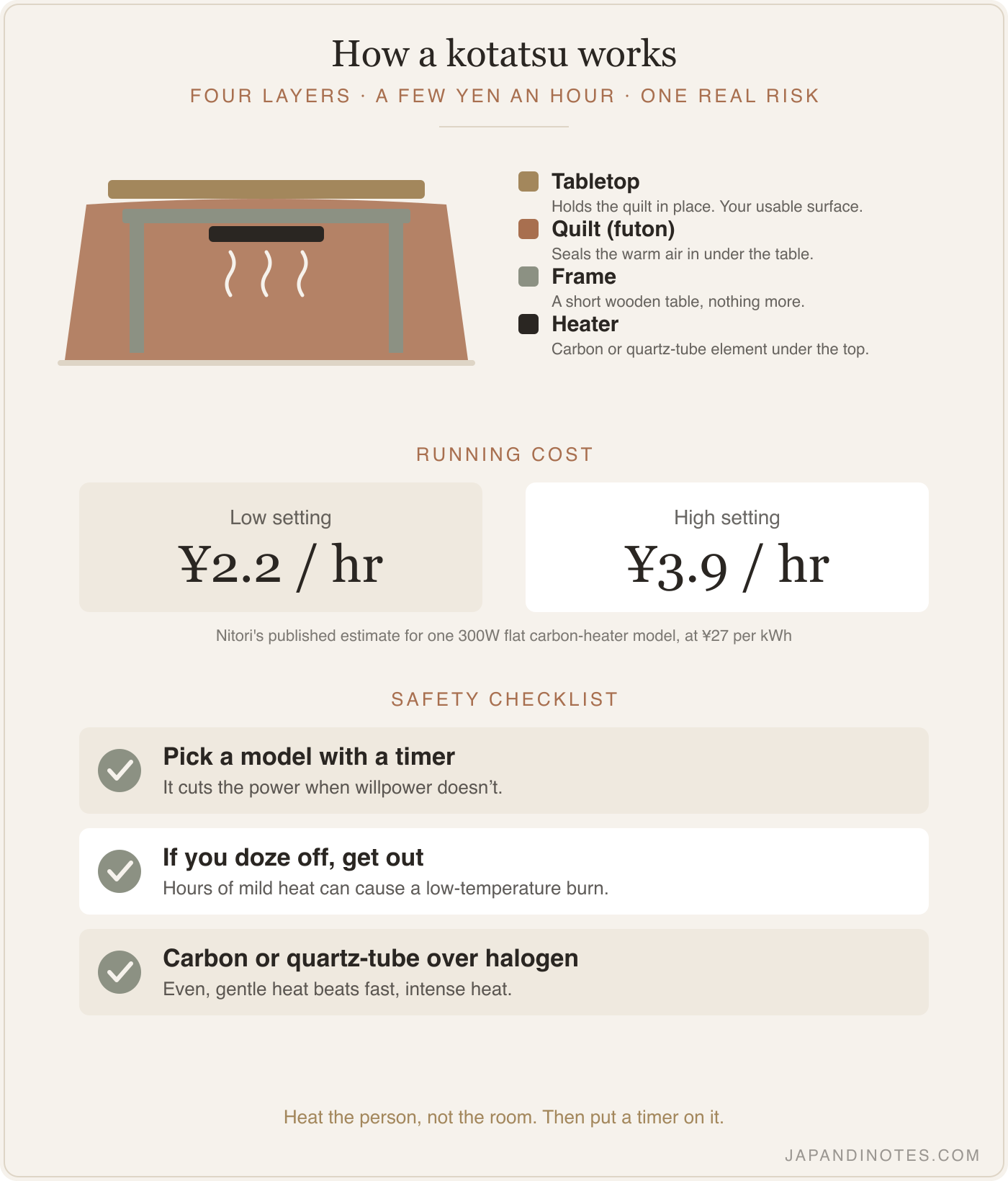
Take the heater away and a kotatsu is just a short table. Put it back and you have three stacked layers: the frame with a heating unit — usually a quartz-tube or carbon-fiber element — screwed to its underside, a heavy quilt draped over the whole frame so the warm air has nowhere to escape, and a hard tabletop on top of that holding the quilt in place and giving you a flat surface to actually use. You sit on the floor or on a cushion, slide your legs in under the quilt, and the heater only has to warm a few cubic feet of trapped air instead of a room.
That’s also why it’s cheap. A modern electric unit draws only a few hundred watts. Nitori’s own product page for one of its tables, a 300-watt flat carbon-heater model, puts the running cost at about 2.2 yen an hour on low and 3.9 yen an hour on high (calculated at 27 yen per kWh) — a few yen an hour, in other words, which is the cheapest heating math you’ll find anywhere in a Japanese home. We already covered what the table itself costs to buy — a bare unit starting around ¥5,000 to ¥8,000, a full set with a nicer quilt running ¥25,000 and up — so I won’t repeat the numbers here. The running cost is the part that actually explains why nobody here thinks twice about leaving one on all afternoon.
Where it actually comes from
The kotatsu didn’t start as a table at all. It grew out of the irori, the sunken hearth cut into the floor of older Japanese houses, and the earliest version — dating back to the Muromachi period — was just a wooden frame set over that hearth with cloth draped across it to hold the heat in. By the Edo period that had become a charcoal brazier tucked under a low table, which stayed the standard setup for centuries before electricity quietly replaced the coals sometime in the 20th century. The shape never really changed. Only the heat source did.
There used to be an actual date for switching it on, too. Edo-period households waited for the Day of the Boar in the tenth lunar month — the boar being, in the old zodiac logic, an animal that wards off fire, so starting your heater on its day was supposed to keep the house from burning down that winter. Nobody I know still checks a lunar calendar for this, but the instinct survives in a looser form: most households here start thinking about getting the kotatsu out around rittō, the traditional first day of winter in early November, when the cold stops being deniable.
What it actually looks like in a real house
My parents’ place in Gunma has one. My in-laws, on the Tango side of Kyoto, have one too. Both put it away for the summer and bring it back out once it’s cold enough that nobody wants to argue about it. Some families never put theirs away at all and use it year-round as a regular table with the heater off; neither set of parents in my own family does that.
My own apartment doesn’t have one.
That’s not a Japandi styling choice. It’s the direct result of the one real design flaw in the whole system: a kotatsu is so good at keeping your legs warm that it makes you fall asleep, and falling asleep with your legs locked in a pocket of 40°C-plus (100°F-plus) air for hours is a genuinely bad idea. I’ve done it. Everyone who’s grown up with one has done it. You wake up groggy, dehydrated, and — if you’re unlucky — with a dull red patch of skin that’s the early stage of what’s called a low-temperature burn, from hours of mild heat rather than a single moment of high heat. There’s an old piece of folk wisdom here, zukan-sokunetsu — “cool head, warm feet” — that’s supposed to describe the ideal state for sleeping. A kotatsu nap is that principle taken past its useful limit: your feet get too warm, for too long, while you’re unconscious and can’t tell. I’m not a doctor, and I’m not claiming a kotatsu nap gives you a cold the way a virus does. I can tell you it’s the reason my own house doesn’t have one plugged in — once a kotatsu was out, I kept falling asleep in it instead of in my futon, and it kept getting left on for hours. That seemed like a bad habit to keep, so I stopped keeping one.
If you’re going to use one, use the safety features modern units actually have instead of trusting willpower. Most current models offer at least a few heat settings and, on better units, a timer that cuts the power after a set stretch. That timer is worth paying for. It’s the difference between an afternoon nap and a three-hour one.
Should you get one outside Japan
Honestly, the rental-friendly argument we made elsewhere on this site applies here better than almost anywhere else: a kotatsu heats you, not the room, which makes it a genuinely good fit for a drafty apartment, a converted garage, or anywhere central heating doesn’t reach — the exact spaces a renter usually can’t fix any other way. It’s a much worse fit for a normal centrally-heated house, where you’d be running two heating systems to warm the same few square feet.
One opinion, since the retailer sites won’t give you one: if you’re buying your first unit, skip the halogen-heater models. Their selling point is fast, intense heat, and fast, intense heat is exactly what makes the one real risk — dozing off against heat you can’t feel building — worse instead of better. A flat carbon or quartz-tube element warms more evenly and does the job just as cheaply, which is all a kotatsu needs to do.
The part worth keeping regardless
None of this is an argument against the kotatsu itself. It’s the best piece of furniture either of our family homes owns for an actual Japanese winter, and the same low-to-the-floor logic that makes a Japanese bedroom work — sit low, heat the person instead of the air, keep the object movable — is close to the best version of itself in this one table. Buy the carbon-heater version, put a timer on it, and treat the nap risk as the actual warning label it is rather than a quirky bit of folklore. Skip it entirely if you’ve got decent central heating already; there’s nothing it does for you that the thermostat isn’t already doing.
— Sen

From our print shop
Wall art, made with this palette
Two collections built on the exact five colors from this site — watercolor landscapes and sumi-e botanicals. Instant download, five print sizes per artwork.
See all the prints →The 5 Japandi Principles (Free Cheat Sheet)
The five ideas that actually transfer from real Japanese homes — printable, one page, free.
Get the cheat sheet →