Rooms
The Japandi Bathroom: What Actually Makes a Japanese Bathroom Work (It's Not the Wood Stool)
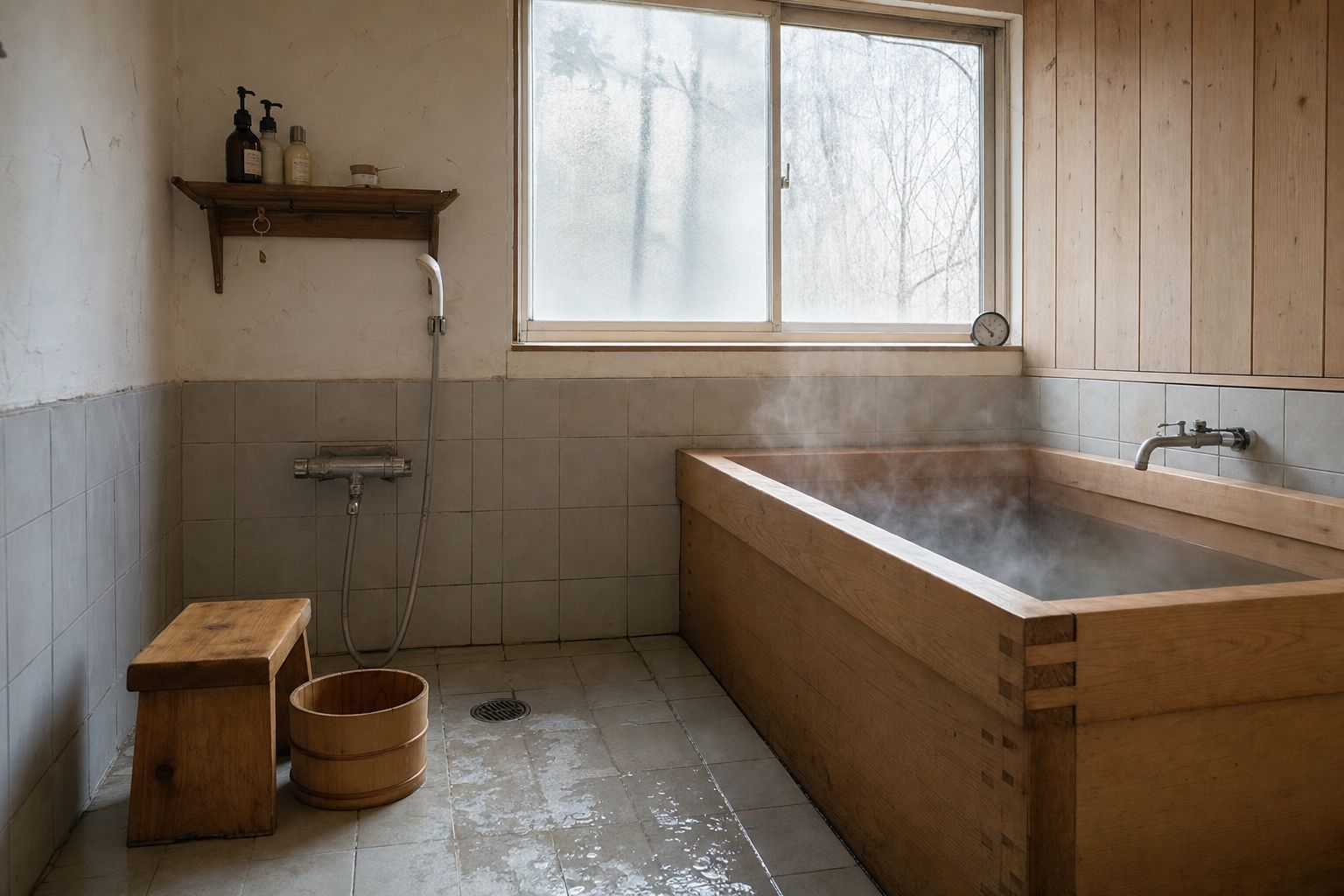
Search “Japandi bathroom” and you’ll get the same three objects in every photo: a wood stool, a stone tray, a linen curtain. Pretty, and also almost none of what makes a real Japanese bathroom feel the way it does. The thing that actually does the work is architecture most guides never mention, because you can’t sell it as a $40 stool.
The short answer: a Japanese bathroom separates washing from soaking — you get clean standing up, on a drainable wet floor, before you ever get in the tub — and the tub itself is deep enough to submerge to the shoulders sitting upright instead of long enough to lie down in. Almost nothing about the look matters as much as that one sequencing rule. Below: the parts of it you can actually borrow, and the parts you’re better off leaving alone.
What’s actually different
A standard Japanese home doesn’t have one bathroom, it has three small rooms doing what your one bathroom does: a separate toilet room (often with its own tiny sink), a changing area, and the wet room itself — tiled or unit-molded, with a floor drain, where you shower and then soak. In small apartments this whole wet section is often a single prefab module, sized in JIS units like “1216” — roughly 120 by 160 centimeters — that arrives as one waterproofed shell instead of being tiled on site.
The tub in that wet room is a different shape than the one you probably have. A Western tub is long and shallow, built for lying down in maybe 35 to 40 centimeters of water. A Japanese tub is short and deep — commonly 55 to 60 centimeters — built for sitting upright with the water up around your shoulders. You wash first, with soap and a handheld shower, sitting on a low stool. Only after you’re actually clean do you get in the tub. Which means the bathwater stays clear enough that in most households, everyone uses the same tub of hot water, one after another, and it often still gets reused for the laundry the next morning.
That’s not a quirk. It’s the whole system working as designed.
The other piece, less architectural and more just a fact of Japanese retail: about 80% of households now have a washlet, the heated, bidet-function toilet seat TOTO first sold in 1980. It’s such a default fixture that plain toilet paper alone reads as the unusual choice in a lot of homes, not the other way around.
The rule every Japanese kid learns
Washing before you get in isn’t really a design choice here. It’s manners, and most of us learned it so young we can’t remember being taught: rinse yourself off properly first, then get in the tub. Getting into the bath unwashed is one of the few things in a Japanese bathroom that genuinely isn’t okay.
That one habit is what lets the rest of the system work. The tub gets filled once and shared by the whole household, one after another, and whoever goes last still gets water that’s clean enough to sit in without a second thought — because nobody skipped the stool.
What you can actually borrow
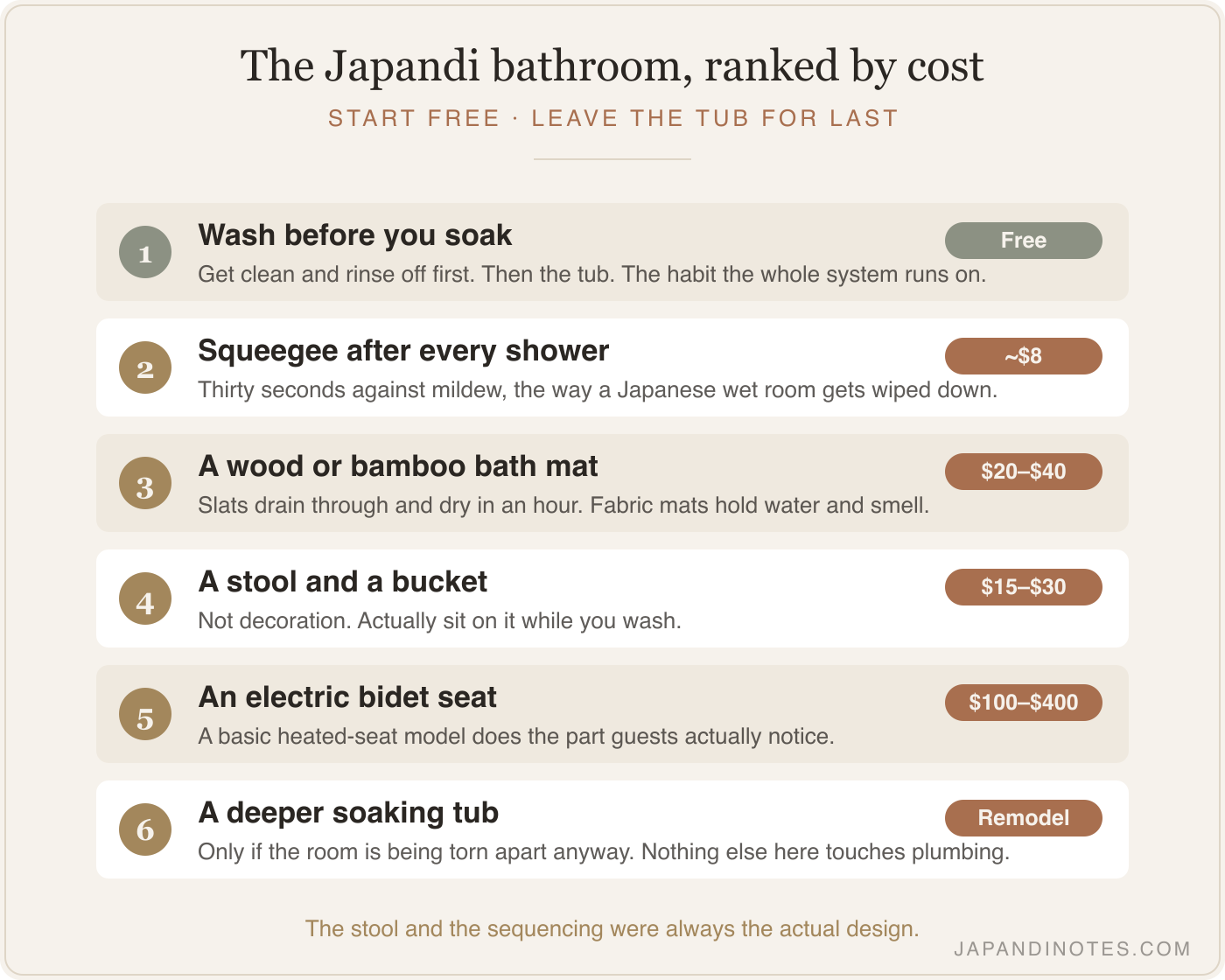
1. Wash before you soak. Free. You don’t need a separate room to do this — a handheld shower head or even just the tub spout works. Get clean first, rinse the soap off completely, then fill or run the bath. This single habit is the entire reason the Japanese system doesn’t need constant water changes, and it’s the one thing on this list that costs nothing and changes the most.
2. Squeegee the walls after every shower, about $8. A Japanese wet room drains and dries fast partly because someone wipes it down every single time. A cheap rubber squeegee does the same job for a Western shower stall in under thirty seconds and does more against mildew than any cleaning spray you’ll buy later.
3. A wood or bamboo bath mat instead of the fabric one you own, $20 to $40. Fabric bath mats hold water and start smelling within a season no matter how often you wash them. A slatted wood mat drains through and dries in an hour, which is the same logic as the drained wet-room floor, just shrunk down to doormat size.
4. A stool and a bucket, $15 to $30. Not decoration — actually sit on it while you wash. It’s a small, real change to how you shower, and it’s the piece most Japandi photos include for the look while skipping the reason it’s there.
5. Worth saving for: an electric bidet seat, $100 to $400. This is the closest thing on this list to a splurge, and it’s the one upgrade that reads as “Japanese bathroom” the instant a guest uses it. You don’t need the top-tier model with a dryer and a nightlight — a basic heated-seat version does the part people actually notice.
6. Worth saving for, if you’re renovating anyway: a deeper soaking tub or a tub insert, several hundred dollars and up. This is the one item that genuinely needs construction, not a swap, so it only makes sense if a bathroom remodel is already happening. Don’t chase it before then — nothing else on this list requires touching plumbing.
What not to bother with
Skip the stone pebble floor insert that shows up in half the Japandi bathroom photos online. It looks the part and it’s a nightmare to actually clean — soap scum and hair collect between the stones, and you end up scrubbing a floor that was supposed to look effortless. A flat wood mat does the visual job without the maintenance.
And don’t buy a matching bath set — stool, tray, bucket, mat, all one brand, one finish. A typical Japanese wet room has a stool that’s been around for years, a plastic bucket from a home center, and a bath mat that doesn’t match either. It works because each piece does its one job, not because the set photographs well.
The part that doesn’t translate
Not everything here is worth chasing. A full three-room split — separate toilet, changing area, wet room — needs actual construction and square footage most homes don’t have to spare, and it’s not worth fighting your floor plan for. And reusing one tub of bathwater across a whole household only works because everyone washes first; skip that step and you’re just skipping the cleaning, not adopting the custom. If you’re not going to do the wash-before-soak part, don’t try the water-reuse part either.
None of this needs a renovation to start. Wash before you soak tonight, add the squeegee this week, and let the tub itself wait until you’re already tearing the room apart for something else. The stool and the sequencing were always the actual design — the wood and the stone tile were just what got photographed.
If you’re working room by room, the entryway runs on the same “cheapest fix first” logic, and a kitchen this size uses the same discipline about keeping only what’s in rotation. Renting and can’t touch the plumbing at all? Most of what actually matters in a rental comes down to what you can undo, and this list mostly already is that.
— Sen

From our print shop
Wall art, made with this palette
Two collections built on the exact five colors from this site — watercolor landscapes and sumi-e botanicals. Instant download, five print sizes per artwork.
See all the prints →The 5 Japandi Principles (Free Cheat Sheet)
The five ideas that actually transfer from real Japanese homes — printable, one page, free.
Get the cheat sheet →