Rooms
Shoji Screens: What the Paper Sliding Doors Actually Are (And What Redoing One Costs)
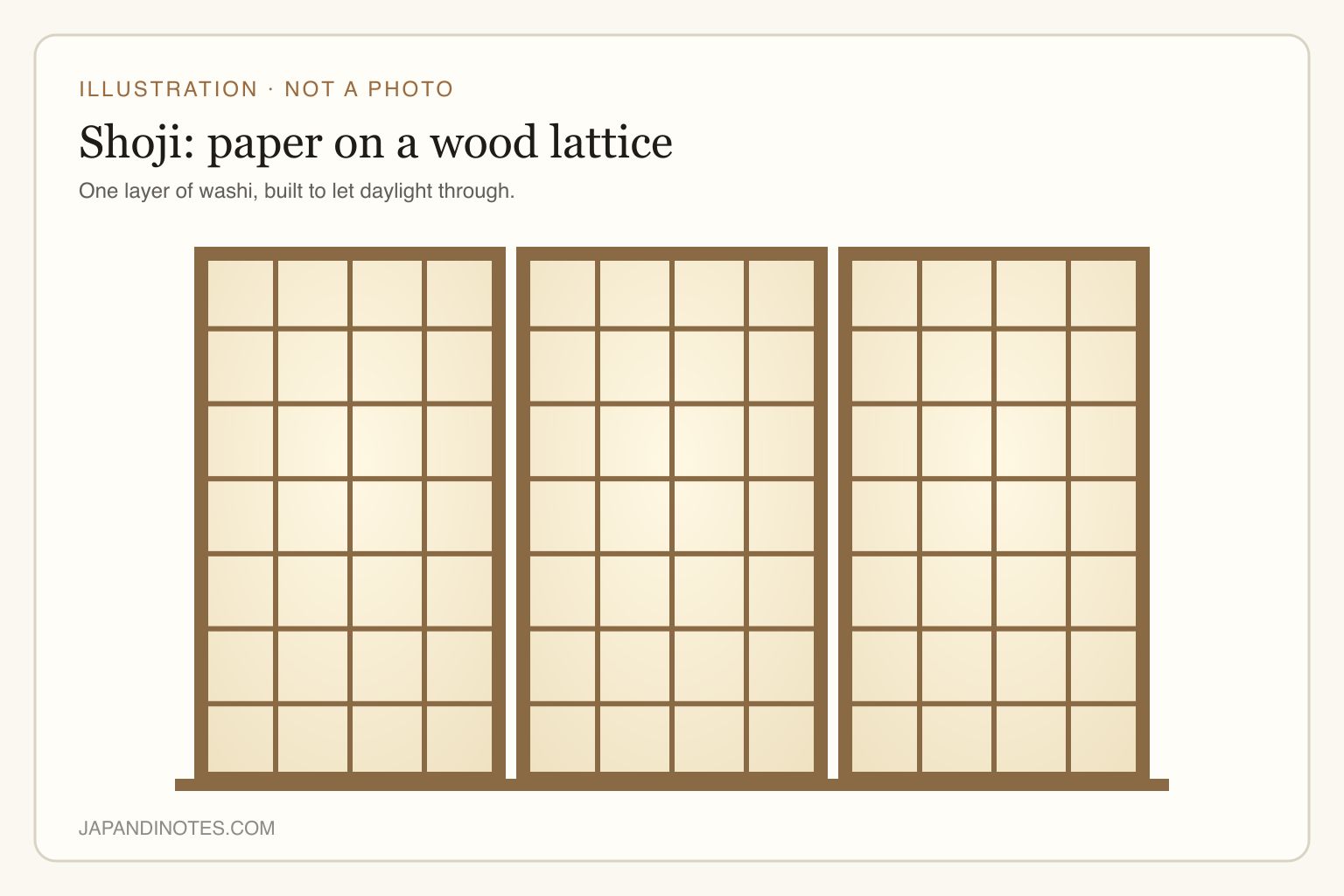
Most Japandi boards use “shoji” as a catch-all for any Japanese sliding door with a grid pattern on it. That’s not quite right, and it’s worth untangling, because the two things people lump together do opposite jobs. The short version: shoji is the translucent one — paper on one side of a wood lattice, built to let light through — while fusuma is the opaque one that blocks it completely, and only one of them is the thing you’re actually picturing when you imagine soft daylight filtering into a Japanese room. The paper on a real shoji also isn’t a permanent material the way glass is; it’s expected to wear out and get replaced, which is a cost nobody mentions when they’re showing you the aesthetic.
Shoji and fusuma are not the same door
Both are sliding panels built on a wooden frame, both show up in the same hallway in a traditional Japanese house, and both get photographed for the same Pinterest boards — which is probably why they get confused so often. The difference is what’s stretched over the frame.
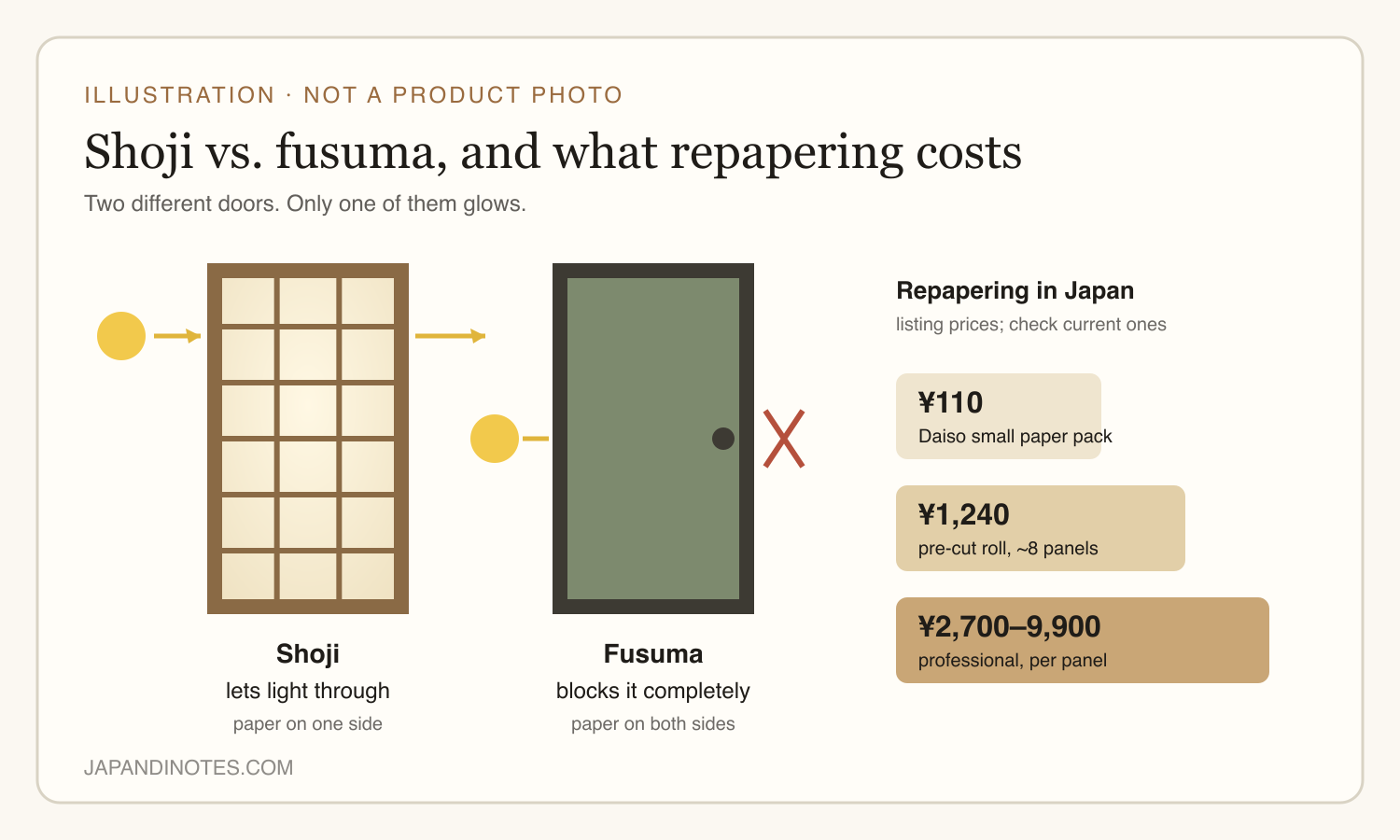
A shoji has a wooden lattice, called kumiko, with a single layer of washi paper glued to one side. Light passes straight through it, diffused into that even, soft glow Japandi boards are actually chasing. Shoji sit on the side of a room that faces outside — between a room and a veranda, a room and a garden — because their entire purpose is managing daylight.
A fusuma is thicker: paper (often a printed or textured pattern, sometimes with a cloth-like finish) is applied to both sides of the frame, and no light gets through it at all. Fusuma divide one interior room from another — between two tatami rooms, say — and function closer to a wall that happens to slide. If you’ve seen a Japanese room split in half to become two rooms for a party and then opened back up, that was fusuma doing the work, not shoji.
So the grid-pattern lattice you’re picturing when you think “shoji” is real. But if the panel in your head is opaque and painted with a landscape, you’re actually picturing fusuma.
What a panel is actually made of
The lattice itself is the part that reads as decorative, but it’s structural first — it’s what holds a sheet of paper taut and flat across an opening that can be over a meter wide without the paper sagging or tearing on its own. Basic kumiko is just a grid of thin wood strips, vertical and horizontal. Higher-end versions use the same joinery technique to build geometric patterns — asanoha (a hemp-leaf motif), for one — entirely from notched, interlocking wood with no nails or glue holding the pattern together. That’s the part of a shoji a woodworker would be showing off; the paper is almost beside the point to them.
Panel sizing isn’t a fixed national standard the way a sheet of drywall is, but home-improvement retailers in Japan sell replacement paper cut to fit a panel roughly 94cm wide and about 2.15m tall, which is close enough to a de facto norm that most residential shoji fall somewhere near it. Go wider than about 90cm and a panel starts getting classified as oversized in traditional joinery references; properly oversized panels run 1.2 to 1.35 meters wide, built that way on purpose to span a larger opening with fewer seams in the frame.
What redoing one actually costs in Japan
This is the part that doesn’t make it into Western write-ups, because it assumes you’ve never had to deal with washi paper that’s gone yellow, torn, or has a cat-shaped hole in it. Real shoji paper isn’t meant to last forever — it’s a maintenance item, the same way tatami matting is.
At the cheap end, Japanese home centers sell traditional mino-size paper sheets — the kind meant to be layered in overlapping strips the old way — for as little as about ¥110 for a small pack at Daiso. Most people doing this themselves these days skip the strip method and buy a pre-cut roll instead: a roll of plain paper sized to a 94cm panel runs around ¥1,240 for a length that covers roughly eight panels, which works out to under ¥200 of paper per panel. Home centers like Cainz also sell reinforced versions aimed at households with kids or pets — paper rated as several times harder to tear than the plain kind, and even a plastic-film “shoji paper” that skips washi altogether for something closer to indestructible.
Paying someone else to do it costs more, unsurprisingly. Professional repapering through a home center or handyman service runs somewhere in the ¥2,700–9,900 range per panel as of recent listings, depending on paper grade and whether they’re removing the old paper first.
The cheaper route, if your town has one, is a silver jinzai center — a local service staffed by retired residents that does small home jobs for a fraction of a contractor’s rate, sometimes starting around ¥1,020 a panel. It’s a very Japanese kind of infrastructure: cheap labor from people who’ve got the time and the patience for exactly this kind of fiddly, repetitive job.
What’s not worth buying
Skip the adhesive window film printed with a shoji-style grid pattern, sold as a stick-on shortcut for a glass door or window. From a few feet back it reads as the right idea. Up close it falls apart as an illusion — the “lattice” is a flat printed line with no actual depth, and the film diffuses light unevenly compared to real washi, which tends to look patchy rather than soft once the sun actually hits it. If you want the real optical effect, a plain paper lampshade does more honest work for less money than a fake grid taped to a window.
Bringing a little of it home
You don’t need a sliding door built into the wall to borrow the idea. A freestanding shoji-style room divider — a folding screen on hinges, usually three to six panels — gets most of the way there for a room that has no actual opening to put a sliding door in. On the lower end, a basic wood-and-paper folding screen runs somewhere around $70 to $100; mid-range versions with a proper window-pane lattice land closer to $170; six-panel or larger versions from furniture-focused sellers can run $200 or more. The cheapest ones are worth being skeptical about up close: the “paper” panel is often a thin plastic diffuser sheet rather than real washi, and the hinges on a $70 screen tend to feel loose within a year of regular folding. None of it is a real shoji door, and none of it needs to pretend to be — a folding screen does the one job that actually matters at home, which is breaking a straight line of light or sightline into something softer.
The cheaper version of the same idea, if a whole screen is more than the room needs: a single paper or linen lampshade does the identical trick at lamp-scale instead of door-scale, for a fraction of the cost and zero floor space.
What this guide is (and isn’t)
To be straight about where this comes from: this is a research guide, not a how-I-did-it story. I haven’t repapered a shoji myself, and the prices above come from Japanese retailer and service listings rather than a shelf check at a local home center this month. Paper sizes and service rates move, so treat the numbers as a ballpark and check a current listing before you budget around them. If I do get my hands on one, this is the page that gets the more specific version.
Quick recap:
- Shoji is translucent (paper, one side, lets light through); fusuma is opaque (paper, both sides, blocks light) — they aren’t the same door.
- A standard panel runs roughly 94cm wide; paper to repaper one costs under ¥1,500 at home centers, professional installation runs roughly ¥2,700–9,900 per panel.
- A freestanding folding screen is the realistic way to borrow the effect without a built-in sliding door, starting around $70.
If a room in your own place has one hard, flat source of light you’ve never liked, that’s the thing worth testing this idea on first — a lamp with a paper shade, before anything bigger.
— Sen
The tokonoma alcove and the rest of a traditional room’s layout gets covered in the Japandi living room guide, the same filtered-light idea at lamp scale shows up in the Japandi bedroom guide, what a rental can actually borrow from all of this without construction is in the Japandi rental guide, and the tatami-floored room a shoji door often opens onto is explained in the tatami room guide.
Wabi-sabi: let it be imperfect.

From our print shop
Wall art, made with this palette
Two collections built on the exact five colors from this site — watercolor landscapes and sumi-e botanicals. Instant download, five print sizes per artwork.
See all the prints →The 5 Japandi Principles (Free Cheat Sheet)
The five ideas that actually transfer from real Japanese homes — printable, one page, free.
Get the cheat sheet →