Principles
Osouji: Why Japan's Year-End Clean Runs on a Calendar (And Two Dates You Don't Touch a Broom)
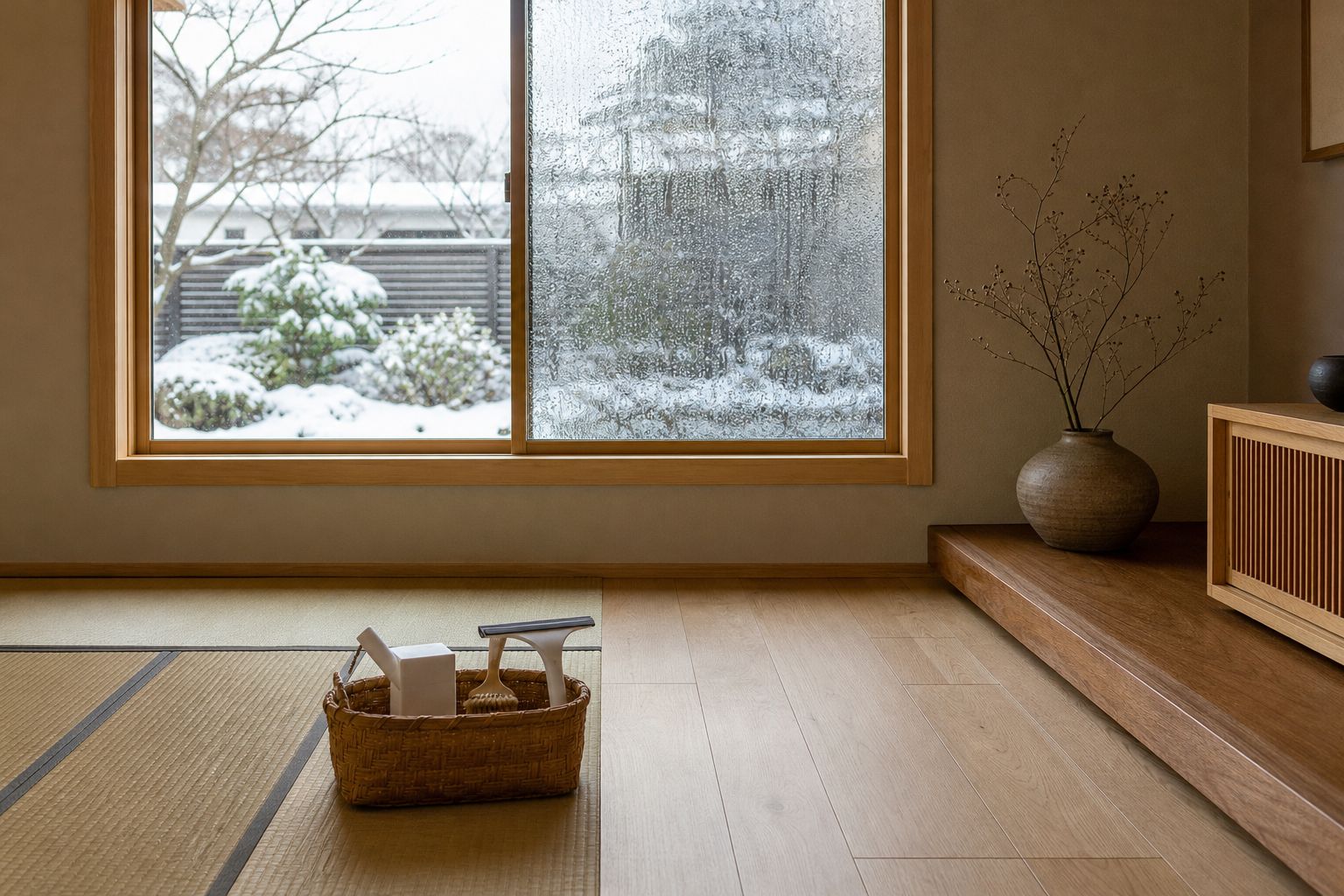
Scroll through English-language home content in the first week of January and you’ll see the same promise everywhere: new year, new you, time to declutter. In Japan, the equivalent clean already happened weeks earlier, inside December, timed to a specific date on the calendar — and for a reason that has almost nothing to do with tidiness.
The short answer: Japan’s year-end deep clean, osouji, traditionally starts on December 13th and wraps up by the 28th. Two dates inside that window are off-limits — the 29th and the 31st are both considered bad luck to clean or decorate on — and the deadline itself isn’t arbitrary. The whole point of osouji is to have the house ready before toshigami, the New Year deity, arrives, which changes which parts of the job actually matter and which ones don’t.
Why December 13th, Specifically
The date traces back to a Shinto-linked custom called susuharai — literally “soot sweeping.” Households used to cook and heat with open hearths and charcoal braziers, and by the end of the year the ceiling beams and paper screens had a real layer of soot on them that needed clearing before anyone could call the house ready for a new year. Court records place early versions of the ritual back in the Heian period, but the date most people associate with it today comes from the Edo period: starting in the 1640s, Edo Castle held its susuharai every December 13th, and ordinary households fell into line behind the same date. Some regions counted the official start of New Year preparations from December 8th instead — the custom was never perfectly uniform across the country — but the 13th is the one that stuck nationally and the one still printed on Japanese cleaning guides every winter.
The soot is gone. The date isn’t.
The Two Days You Don’t Touch a Broom
Open any Japanese osouji guide and you’ll run into the same two warnings, almost word for word. December 29th is out because 29 reads as niju-ku, close enough to the word for “double suffering” (二重苦) that it’s been treated as an unlucky number since the Edo period — not something you want attached to how your year starts. December 31st is out for a completely different reason: finishing the cleaning or putting up decorations the night before is called ichiya-kazari, “one-night decorating,” and it’s avoided because throwing the preparation together at the last minute is treated the same way a funeral arranged overnight would be — rushed, not readied. That leaves a working window of the 13th through the 28th, with the 30th usually treated as an acceptable last-chance day, which is also why Japanese osouji advice tells people to start absurdly early by Western standards. A two-week runway isn’t superstition stacked on top of itself. It’s what’s left once you cross off the two days that don’t count.
It’s Hosting, Not Just Decluttering
What that deadline is actually clearing the house for is the part most English coverage skips entirely. Osouji exists to get the house ready to host toshigami, the deity said to visit every household at the New Year — the same deity that kadomatsu, shimekazari, and kagamimochi exist to welcome once the cleaning is done. A household that keeps a kamidana, a small shelf-shrine, gives that shelf its own dedicated cleaning during this window, handled separately from the rest of the house. The previous year’s omamori and ofuda — protective charms and shrine tablets — get gathered up to be returned to a shrine’s old-charm collection box, or burned at a dontoyaki bonfire around January 15th, clearing the way for new ones bought on the first shrine visit of the new year.
Plenty of ordinary households today don’t keep a kamidana at all, and that’s completely normal. The calendar logic around osouji outlasted the religious habit that originally justified it, the way a lot of seasonal customs do once you actually look into where they came from instead of taking the surface version at face value.
Borrowing the Calendar, Not the Scale
None of this requires believing in a visiting deity to be useful. What’s actually worth copying is the mechanism behind it, not the religious scale of it.
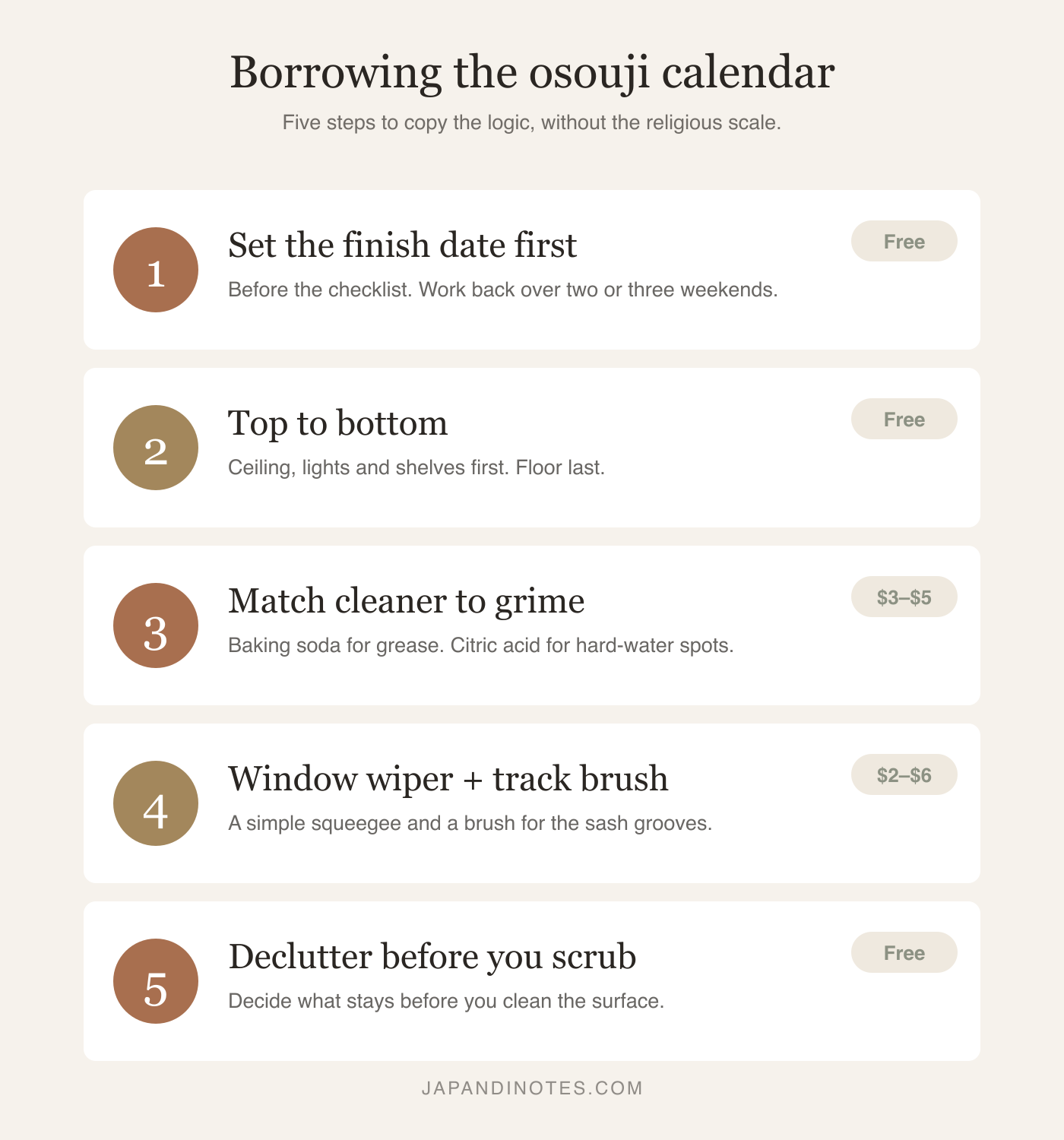
1. Set the finish date before you make a checklist. Free. Pick a date roughly two to three weeks out and work backward across a couple of weekends, instead of planning one exhausting marathon day. The whole reason osouji opens on the 13th is that nobody expected a full house to get cleaned in an afternoon — it was never designed to be a sprint.
2. Go top to bottom: ceiling and shelves first, floor last. Free. This is the direct descendant of soot-sweeping logic — dust and grime fall down, so wiping a light fixture or the top of a bookshelf after you’ve already vacuumed just creates a second vacuuming job.
3. Match the cleaner to what’s actually on the surface, $3–$5 a box. Baking soda is mildly alkaline and works on oily, acidic residue — stovetop grease, range hood buildup, scorch marks. Citric acid works the other direction, cutting through alkaline mineral deposits like hard-water spots around a faucet or soap scum on glass. Buying one all-purpose spray and using it on everything is the single most common reason a “deep clean” doesn’t actually look different afterward.
4. A simple window squeegee or wiper, $2–$6. In Japan these show up in every 100-yen shop display every December, usually bundled with a small window-track brush for the sash grooves — cheap enough that buying one every year instead of hunting for last year’s is a completely reasonable call.
5. Declutter first, scrub second. Wiping down a shelf that’s still covered in stuff you were going to throw out anyway wastes the cleaning. This is the exact same principle behind how an oshiire closet stays usable in the first place — sort what’s staying before you spend any effort making the surface shine.
What Not to Bother With
Skip the single-day, top-to-bottom marathon the night before guests arrive. It’s the ichiya-kazari problem with a vacuum instead of a shimekazari — rushed, exhausting, and it guarantees you’ll skip whatever’s hardest to reach. Skip renting a steam cleaner or pressure washer for an apartment-sized clean too; the cost-to-benefit math on a once-a-year rental almost never works out for a space that size, and a bucket of hot water with citric acid does most of the same job on tile and glass. And if the only weekend you have free happens to land on the 29th or the 31st, just do it then — it’s a Japanese folk superstition, and nobody but you is enforcing it on your own calendar.
What’s worth keeping from all of it is the shape of the plan: a fixed deadline, a fixed order, and two dates ruled out before you even start negotiating with yourself about when to begin.
Quick recap:
- Osouji traditionally runs from December 13th to the 28th, and the 29th and 31st are the two days people avoid.
- Clean top to bottom, use baking soda on grease and citric acid on hard-water spots, and declutter before you scrub.
- The deadline exists to have the house ready for the New Year, not to make it spotless.
Your next step: pick your own finish date this week, then count back two weekends from it.
— Sen
For the rest of what this clean is actually making room for, the three objects it’s preparing the house to welcome are explained here; if the closet is the part that quietly never gets touched, the same sort-first logic applies there too; and the genkan — the one spot every guest, and supposedly the deity, actually walks through first — runs on the identical cheapest-fix-first approach; the bigger idea behind storing and cleaning less instead of more is laid out in what real Japanese homes actually look like.
Wabi-sabi: let it be imperfect.

From our print shop
Wall art, made with this palette
Two collections built on the exact five colors from this site — watercolor landscapes and sumi-e botanicals. Instant download, five print sizes per artwork.
See all the prints →The 5 Japandi Principles (Free Cheat Sheet)
The five ideas that actually transfer from real Japanese homes — printable, one page, free.
Get the cheat sheet →